
The first skateboard craze had come and gone. SurfGuide Magazine publisher and Makaha Skateboard founder, Larry Stevenson had started a new business. The Young American Research Institute (YARI) had been set up to study, analyze and report on the phenomenon known as “the youth market.” YARI also advised clients how to tap this market and, in certain cases, worked with clients, their design teams and advertising people to come up with youth oriented products and create campaigns to promote and sell the products. Schick razors new line of pop-art and psychedelic themed razors was an example.
Since Larry had been intimately involved in the youth market and responsible for creating one of its greatest success stories with Makaha skateboards he was well suited to the task and had a lot of credibility.
Larry offered me the job of editor of YARI’s monthly newsletter, Young American Report. The newsletter reported on youth market trends and market research that predicted emerging trends, and was sent to clients and potential clients.
The research side of things was headed up by Dr “Hal” Halvorson, who was a market research specialist and professor at UCLA’s Graduate School of Business.
After editing just three issues and seeing the demand for the publication grow, Larry decided to bring in my old editor at Surfguide, Bill Cleary. After Surfguide’s demise, Bill had joined Surfer Magazine as its associate-editor. But he’d recently resigned and was looking for a new challenge.
Despite my sudden demotion to assistant editor, it was a good move, because I was very aware that I was far too inexperienced to take the publication to the next level. Actually, it was a huge relief, because I enjoyed the writing, researching and interviewing far more than all the client liaison, ass kissing and production supervision that came with the editor’s job. Besides, I’d also been given an additional responsibility which I very much enjoyed.
After a couple of weeks of training under Professor Halvorson, I was given another title – “research assistant” – and not only started taking part in research assignments but was also introduced to the Machiavellian art of constructing market research questionnaires and surveys.
What fascinated me then and still does is how a questionnaire or survey can be worded or skewed to elicit responses that either support or undermine a certain position or supposition. Even today, I can look at a questionnaire or take part in a survey and quickly determine whether this is or isn’t the case. Fortunately, most projects are constructed fairly, which means the outcomes can be fairly representative. But others, especially political surveys, can be very biased. Which is why I don’t put much stock in them.
As time went on and the business grew, I became involved in yet another facet of the business – the “Teen Fairs.” While at SurfGuide, Larry organized two major surf industry exhibitions at the Santa Monica Civic Auditorium. They were a lot of work and getting all the exhibitors and entertainment together at the “Surf Fairs” for a couple of days was exciting and intense. It was also a lot of fun and the buzz was like the ones I’d be treated to years later when I was tour manager for the Benson & Hedges Fashion Awards shows that toured New Zealand with my wife as one of the dancer/models.
I guess the highlight of my time with YARI was when the Wall Street Journal wrote a very complimentary article about one of the YAR articles I worked on with Bill. While doing research on another subject, we’d discovered that two major tobacco companies had trademarked two of the most popular varieties of marijuana: Panama Red and Acapulco Gold. Further research and interviews had revealed that the companies were preparing for a time when the use of marijuana would be legalized and its sale regulated and taxed in the same way as tobacco.
The story was quite a journalistic coup and YARI gained a number of new corporate clients as a result.
To give you an idea of the league YARI was in, our mailing list included oil companies, car manufacturers, toy manufacturers, soft drink companies, tobacco companies, record companies, cosmetic companies, film companies, fashion houses, retail chains, major advertising agencies and television networks – even political parties. In other words, all of Fortune’s 500 plus the next level down.
I remember getting a phone call one day when, for some reason, everyone but me was out of the office. The voice sounded familiar, but I couldn’t put a name or face to it.
“Hi, this is a client of yours and I’d like to ask you an off the cuff question.”
Strictly speaking, I should have asked him which client and for his name, but figured an off the cuff question wouldn’t hurt and the voice sounded friendly.
“A pleasure. I’ll do my best.”
“Right … there’s a music oriented variety show coming up on television and the target market is early to late teens and early twenties. Who do you think we should get to MC the show, Peter Fonda, Pat Boone or Dick Clark?”
To me it was a no-brainer and, without thinking of the consequences, I answered, “Peter Fonda.”
There was a long silence on the other end of the phone followed by a not so friendly, “Why Peter Fonda?”
“Well …,” said I. “Peter Fonda is more part of that generation and his last two films have given his image a bit of a dangerous edge that teens find attractive.”
“But those films were … were about drugs and sex!”
He was partially right. “The Trip” was about drugs and sex, and “The Wild Angels” added a motorcycle gang, violence and rape to the mix. What more could a teen ask for in a movie?
“Sorry, but to put it put it another way, Fonda has sex appeal and that’s my off the cuff opinion.”
“So what about Pat Boone and Dick Clark?”
I probably should have moderated my response, but the question struck me as ludicrous. “Sex appeal? You’ve got to be kidding. Pat Boone has about as much sex appeal as a pink carnation and Dick Clark is more like someone’s father.”
“Are you sure about Dick Clark?”
Something in the way he asked made me hedge my bets. “Let me put it like this. Dick Clark was right there when all this youth market stuff began and was part of making it happen. But that was then and now he’s become more of an institution. My opinion is that teens will respond more favorably to a younger, more ballsy host. But why not arrange for some hard research that will tell you if I’m right or not.”
“Thank you … no. But I’ll think about it. Thanks for your opinion.”
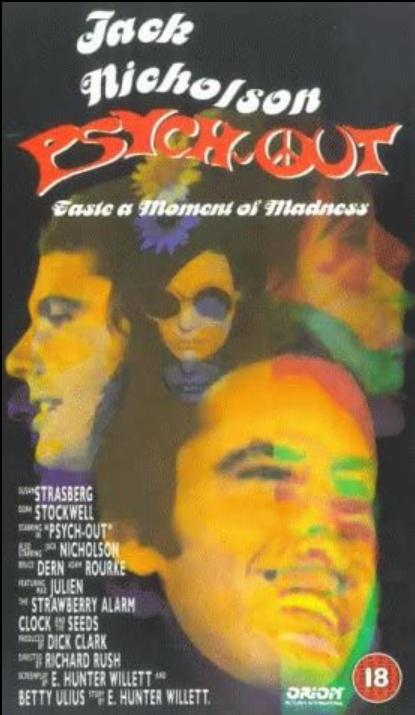
A few days later, I was informed that the client was Dick Clark Enterprises and the caller was Dick Clark himself. No wonder he sounded so deflated at the end of the call. What surprised me was learning that his production company had produced a film called “Psyche-Out” which featured sex and drugs, albeit in a much more tame, moralizing format than “The Trip”. I never saw it but understand it was the kind of film I would have liked to have seen while stoned at a drive-in with friends in a smoke filled car. From the trailer I’ve viewed on the IMDb website it was very laugh worthy.
Dick Clark wasn’t pleased © Robert R. Feigel 2022 – All Rights Reserved
 Pieces from a Puzzling Life
Hahahahaha!!!! What a great story….
LikeLiked by 1 person