
Anyone who has seen the Harry Potter films remembers Harry’s cupboard under the stairs. This small space was where Harry was forced to live by the Dursleys, the aunt and uncle he had to live with after his parents were murdered.
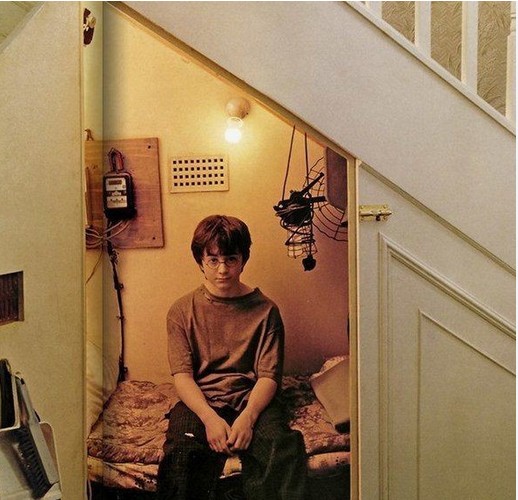
Those scenes resonated with me by awakening memories of a real boy who’d been forced to live under the stairs.
In the mid-60s circumstances led me to go back to Evansville College in Southern Indiana in an attempt to complete what I’d walked away from earlier and earn a degree.
To begin with I lived with my dad, stepmom and little brother. But the time came for me to get a job and move out on my own. My stepmom was a volunteer with a mental health organization and heard that the support agency for the intellectually handicapped was looking for a driver. I got the job.
The job entailed driving a 12 passenger “shuttle van” that would deliver up to 12 passengers to a spot where they’d be taken the rest of the way on a full sized school bus. The reason for this was the difficulty the big bus would have negotiating the narrow, remote rural areas outside of suburban Evansville.
This meant an early start so I could pick up everybody and arrive at the rendezvous spot in time for the big bus to deliver everyone by the start time at the center. The younger people went to a training school and the older ones to a workshop. My youngest passenger was maybe 8 or 9 and the eldest in their late-40s.
I really enjoyed the job and got to know my passengers well during our daily journeys. We’d sing, joke and I learned a lot about the individual ways their “handicap” affected each of them. Some exhibited what I came to think of as the classic Downs Syndrome appearance. Other’s exhibited no hint of any abnormality until they started to interact with me and the others. To put it another way, each of my charges was defined by their individuality and not their supposed “handicap.”
With some I was able to have perfectly normal conversations. Others were like difficult, petulant children. And, on occasion a couple could be truculent. There was no normal or rule.
It soon became clear that I could rely on a couple of my charges to help look after the others if I had to park and leave the van momentarily to assist one of the physically handicapped passengers into the van. They’d also help those who needed it to get in or out of the van. We’d become a family or team of sorts, with each of us playing our parts.
There was one problem person of course. He was in his 40s and would sometimes get angry and abusive. With him I had to be very firm, which sometimes upset some of the more gentle and reserved people.
People. Yes … they were all people with individual, unique personalities and emotions. For me, it was a steep learning curve and a wonderful experience.
The most enlightening and immensely rewarding experience was being able to spend time with the boy from under the stairs. I was summoned to a meeting at the center administration office by my boss and found myself in a meeting with her and two of her colleagues. They wanted to brief me about a challenging new passenger and warn me that I might encounter some problems with the boy’s parents.
They told me that he was around nine or ten and that his parents had been forced by court order to send their son to the the to attend the school. The boy didn’t speak and never had. He’d been locked away in a cupboard under the stairs and kept separated from the rest of his family. The neighbors had never seen him outside and the authorities weren’t even sure of his exact age.
According to the brief his parents were fundamentalist Christians belonging to some sect I’d never heard of and that they thought the boy and his condition were caused by them having committed the sin of having consumed alcohol when he’d been conceived. His condition was the punishment for their sin and the sin was something they wanted to hide from their sect community. How the authorities discovered all this and rescued the boy was not something that could be revealed.
I was to drive up as close to the boy’s home as close and as discretely as possible I was to go to the front door, knock once and wait for the boy to come out. I was, under no circumstances, speak to anyone who came out with the boy. Or look at them.
That first day I was apprehensive, especially after I arrived at the house and saw it. It was like something out of an old movie. An old, two story wooden house that might have been a farm house surrounded by fields in the past. It was still in a rural area with no houses nearby, but the property was bleak, unkept with no grass and the house was dilapidated and in need of paint, maintenance and repairs. The stairs creaked as I walked up onto the front porch and knocked once on the door.
After several moments the door opened and a woman pushed a boy out onto the deck and swiftly closed the door.
The boy was dressed in what looked like hand-me-downs. Without looking at me he glanced around briefly before looking down at his feet.
Feeling at a bit of a loss I lamely introduced myself and told him we were going to go to the van. At that he looked at the van and put his hand in mine. His hand was cold.
We walked to the van and instead of sliding open the side-door and seating him inside with the others I opened the front passenger door and buckled him into the seat across from me. Then I introduced him to the regulars and they all chimed in with hellos while he continued to look down at his feet. As we pulled away he looked up at the house and I saw a curtain fall back in place. As if the regulars sensed the awkwardness the rest of the journey was made in silence.
His name was Daniel and except for the front door opening and closing with only Daniel coming out the next couple of days were a replay of the first on Wednesday. So on the following Monday I decided to change the routine. I restarted the banter the regulars and I had previously enjoyed and got laughter and singing back on track. Somewhere along the line I’d learned that children don’t like to be talked down to and appreciated being talked by adults as adults. I included Daniel in the conversations and would ask him questions even though I’d been told he’d never uttered a word before.
Somehow, I’d gotten the impression that he understood what all of us were saying and it was confirmed and encouraged when he finally nodded with an affirmation after a question.
The breakthrough came unexpectedly. One day a later pick-up was tardy and I honked the horn outside their home. Daniel’s head jerked up and over to me and then to the steering wheel. This led to me saying, “horn” and pointing at it. For the first time he smiled and I tapped the horn and repeated the word several times. I could tell he was trying to speak but was having a hard time figuring out how. After several tries and obvious frustration he managed to form something that sounded close to horn but wasn’t quite it.
I only had the morning run so my time with my passengers was limited. As Daniel was one of my middle pick-ups before meeting the main bus my time with him was even more limited. But we concentrated on “horn” for a few more days until we were both satisfied. He had said his first word.
From then on his learning speed increased until he could name and pronounce every part of the van’s dashboard, including wipers … which was a major triumph. We exchanged names and so did most of the other passengers. He was slowly but very surely learning how to talk.
After a few weeks of this I was once again summoned by the boss lady, only this time there were several colleagues and someone who was introduced as the director. I was closely questioned about my interaction with Daniel and had to describe everything in detail. I had to wonder if I’d done something wrong. WHEW! At the end I was told that they had been led to believe that Daniel was mentally impaired due to brain damage and would never progress beyond grunts at best. They were amazed and delighted at his progress and could see him one day living a “normal, productive life.”
I was relieved, but unprepared for what happened next. After lots of questions about my life, my aspirations and my plans for the future they told me that they thought that I had demonstrated an unusual aptitude for working with the intellectually handicapped (a term used then but thankfully used less now) and that, with the proper qualifications, I could benefit their area of health care and have a brilliant future in that sector. They offered to sponsor my continued education at a university that offered that kind of program. They’d also guarantee me a job working with the the organization during that period and upon my graduation.
So far so good. Then it all came crashing down. Moving on, I was to be assigned to a new route and wouldn’t have any further contact with Daniel and my regulars from here on out. I’d formed too close of a relationship with Daniel and the other regulars and they to me and that wasn’t considered to be beneficial or acceptable. They knew I’d understand.
I understood perfectly and after saying goodbye to Daniel and the regulars the next morning I dropped off the van keys and quit. They were shocked and contrite but despite the attraction of their offer and the enjoyment I’d had and could have continued to have I knew I wasn’t cut out for that kind of organizational control.
Working in the health care sector requires a deep and very personal commitment that can’t be taught or bought, and should never be undervalued. Yet there seems to be a fundamental fear of any relationships between carer and cared for being anything but remote and impersonal. To me that ignores a very important part of the process. It also demonstrates a lack of trust.
Sure, it’s wrong for a carer to take advantage of their “client” or “patient,” but I know of one remarkable hospice nurse who decided to leave her job because she wanted to administer and support someone she new locally in our community. Why? Because the administrators at the hospice didn’t want their nurses taking care of anyone they actually knew. It’s stupidity like this that make me glad I didn’t carry on in that system.
Boy under the stairs © Robert R. Feigel 2022 – All Rights Reserved

