
Early Memories

I’ve heard it said that a human can’t remember things that happened when they were infants. Granted, I don’t remember much, but I can remember the taste of a toy I got for my first birthday. It was a large (my size) toy soldier. It was a soft, stuffed toy covered in oil cloth that was painted or dyed to resemble a soldier with a tall blue hat.

I was trying to hold it while I was sitting in a high chair at a table and wrestling it to keep it where I could stick parts of it in my mouth and gum it to death. I also tried to chew parts of the high chair’s tray. I slobbered a lot.

The taste of the oil cloth was different than the bland baby food I was used to, although I liked the apple sauce that came in little jars because it was sweet and I could rub it onto everything I wasn’t supposed to including myself.

I don’t know if I was thinking about all this when it happened or if I’m looking back and applying my adult interpretations to the memory. Maybe that’s why it’s the taste of the toy that is so clear.

When I was three I cut off the index finger of my left hand just above the middle knuckle. I remember that clearly. I was spending the summer with my dad and stepmom (and stepbrother) in Indiana and had managed to open the door of the tall cabinet or closet in the garage where my dad left the lawnmower. It was a push mower. The cabinet was locked by means of stick with a knob that might have been a glob of dried creosote or tar and stuck through a hasp and staple. Remove the stick and the door would open.

I’d been warned to never, ever open that door or mess with any of the tools in the garage. Which made my next move a harbinger of a life spent of doing the opposite of whatever my dad told me not to do. I somehow got the stick out of the hasp and the door swung open revealing the mower and some other fascinating things like a shovel, rake and broom. I loved the smell of the oil and of the knob on the stick. I still love those smells.

The mower was angled backwards up against the back wall and the handle was far too tall for me to reach. If I had been tall enough to grab it the heavy wooden handle would have fallen back and hit me on the head and done everyone a favor. Instead I was able to play with one of the wheels and just strong enough to turn it so the mower to rolled forward. To enable me to turn the wheel I was bracing my left hand on one of the blades and when the mower rolled forward the blade snipped off my little index finger leaving it hanging by a bit of skin.

My screams brought Mother Alice from the house and despite the blood and screams she stayed calm and in control. She was able to scoop me up, grab a towel from the washing line, wrap my hand in the towel and get me to the hospital in town holding the bloody towel wrapped hand while driving a stick shift car. This was the summer of 1944.

My memory recall fades at this point so the rest is my memory of what Mother Alice told me years later. She bundled me into the emergency department where we were admitted immediately. After examining the damage the doctor told her that there was nothing that could be done. They’d have to suture the remaining part of the finger after snipping off the skin holding the severed bit above the middle knuckle. At least I’d have a “stub.”

While My stepmom was considering this a young doctor told her he thought he could save the finger. He’d just returned from serving in a field hospital in Europe where the war was winding down and explained that he’d learned some new micro-surgery techniques with combat wounds of this nature. He would like an opportunity to try one of them on my injury.

My stepmom had to sign a release form of some sort and the operation went ahead despite the senior doctors expressing doubt that it would be successful. Mother Alice was told the the severed tendons might not work again but that he was confident he could reconnect the blood veins.

My injured hand was wrapped in layers of dressings with heaps of antiseptics then put in a cast. It had to be re-examined and retreated regularly due to what could happen should the reattachment fail to take. Worst of all I wasn’t allowed in the water.

My mom was incensed when I returned to Florida in a cast and threatened to keep me from returning to Evansville. Her mood didn’t improve when she learned that my finger was, from that summer forward, known as “Alice’s Little Finger.”
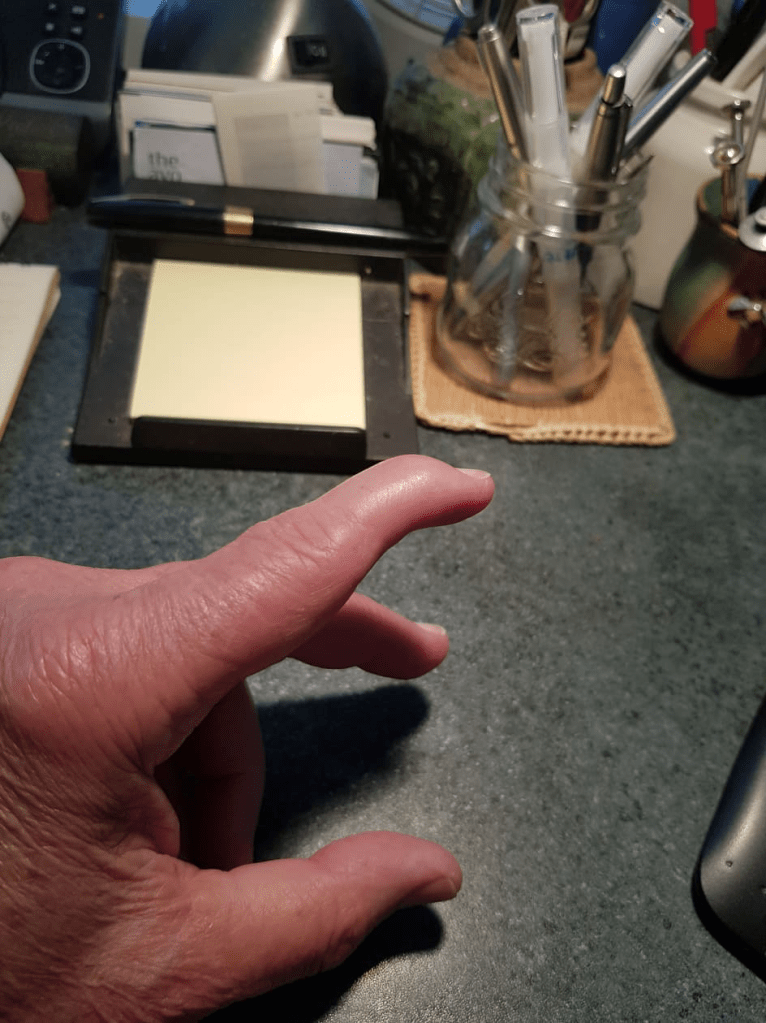
Alice’s Little Finger today.
Taking a typing course in junior high helped strengthen it.
From my middle or second knuckle
it’s deformed and unable to bend on its own.
It’s what got me a 4F deferment in the Vietnam War,
but that’s another story.

I have other memories from that stage of my life. I remember being told to stay away from the canal running behind the apartments I lived in with my mom, stepdad and little sister before we drove the big Packard From Florida all the way across to Malibu where we headed after the war.

The apartments had a back yard where the tenants could dry their washing and beyond a chain link fence there was canal. I was warned that the canal had alligators in it and that a little boy my size had been dragged away by an alligator and never seen again because he didn’t listen to him mother when he went beyond the fence.

Apparently, I was a little terror and my mom put me in a harness when we were out to keep me from running away. But that was a warning I respected.

Before I learned to walk and run I have a memory of crawling. I remember it because that was when I became aware that choices have consequences and it was up to me to choose if a consequence was worth the choice I’d make.

I loved to crawl and was getting good at it. I can’t remember where this was but the floor was carpeted. The surface provided me with more traction than wood or linoleum so I could crawl more quickly. So I was working on my speed demon act when I began to realize that there was a point beyond which the insides of my chubby knees would start to burn. Was crawling as fast as I could worth it? Of course it was and I found that if I got to a certain footstool and pulled myself up off the carpet I could give myself just enough time to recover and start again. It was a joyful experience and steadying myself while standing at the footstool helped me learn how to walk. But until I learned how to run I could still crawl faster than I walked and would revert to that.

Later, I had a far less joyful experience when I found one of my mom’s bobby pins on the floor. This floor was wood and in the Florida apartment. Nobody had warned me not to do this because they probably didn’t think I’d be silly enough. You probably guessed it. I stuck the bobby pin into a wall socket and was thrown across the room into the sofa on the opposite wall. Shortly after that performance I tried to eat a glass eyedropper. Needless to say, I kept my families busy.

Early Memories © Robert R. Feigel 2022 – All Rights Reserved

Close Encounters

(As told to Wade Doak) On 12 November 1976 I was out on charter boat Lady Jess from Tutukaka heading back from a day of fishing around the Poor Knights along with some friends. There were probably twelve or so people on board and most of them were either aft or on the bridge with the skipper. I was hanging out one of the cabin doors on the port side thinking of nothing in particular when the inside of my head seemed to come alive with high-pitched sounds and something my mind’s eye saw as multi-coloured dots zigzagging all over the place. If you’ve ever seen one of those electronic ping-pong games … It was like that, but in colour and multiplied by thousands, and the visual experience was connected with the auditory one. It wasn’t a very pleasant feeling because of its intensity but it only lasted a few seconds when BLAM!, out of the water right in front of me jumped a dolphin.

It was huge and I’ve never been that close to any creature of the sea before, but of all things I remember feeling, fear wasn’t among them … only a very intense awareness.

Its jump was a tight arc and when it reached the level of my face it seemed to hang in the air and look me straight in the eyes and then dive back in the water. It came up a short distance away one more time, and everyone on the boat ohhed and ahhed and then it disappeared. All in all I estimate the time involved to have been no more than sixty seconds.

The bouncing, multi-coloured dots were just as real as everything else. It seemed as if my perception had widened. The reality I had been experiencing a moment before was put into the background with this new overlay happening simultaneously — like a double exposure.

There was a hint of another dimension. The multi-coloured dots seemed to zip and zap all over the place, points of light moving infinitely away or close around without becoming larger or smaller, as if there were no up or down, or in or out, but a total 360-degree awareness.

There were more subtle movements too, slight changes in the colours and patterns of the “atmosphere” within which I seemed to be seeing the points of light. This atmosphere was crystal clear yet at the same time produced a sense of colour; a dimensional thing like layers of subtle, changing colours.

The discomfort was not caused by the intensity of the sound. It seemed I was not hearing in the usual sense but listening to sound registering in my head without coming through my ears. The sound was so beautiful, like some absolutely perfect electronic music. The discomfort came from trying to listen to it without hearing.

It would be like getting scared at going fast down a snow hill on a sled and dragging your feet and hands to slow yourself down. Then the thrill and excitement of going fast. Only I felt I was going downhill, afraid of taking off and going on forever. I felt that if I let myself hear and see then I’d disintegrate. It was not the sound or visual effects in themselves that produced discomfort and fear but my trying to handle them.

Both the sound experience and the visual seemed connected, just as the music and light at a rock concert can be connected, yet at the same time they were distinct and separate. Despite the intensity of the experience and discomfort, after it was over I felt as I would if someone I loved very much but hadn’t seen for some time had come into my life for a short visit. I felt relaxed … I felt comfortable … and I felt full of love for everyone.”

Close Encounters © Robert R. Feigel 2022 – All Rights Reserved

The Memory Tree

Last night my wife asked me how my blog was going and I mentioned the sudden insight description. That led to us talking about how the aftermath of my concussion affected both of us and the changes that it made to my memory recall. She was wondering if all the detailed memories came back at once or in a certain sequence.

Neither. At first they’d pop up in no particular order when triggered by something external, like a sound or smell, image, conversation or even words. The memories weren’t always pleasant or enjoyable and I didn’t go looking for them. Sometimes they were so intense and overwhelming that I was left exhausted, trying to focus on something else that would help me escape them.

It was like discovering a ripe fruit on a tree and plucking it off the branch to eat right then and there. It was my memory tree.

Facebook came in handy. It was so unpredictable and eclectic. It often could be something I saw on FB that would trigger a deep memory recall. Then I could usually write the memory out of my system and let it dissipate into the background.

A friend once told me that a memory tends to fade a little every time you verbalize it to someone else. We were discussing spiritual and extra-sensory experiences that could be recalled in vivid detail. I’d noticed that the details of my experience with dolphins was slowly being eroded as I recounted it to others. I’d originally shared my experiences with diver, explorer and author Wade Doak, the man who introduced me to the magic of dolphins through his cetacean communication research called “Project Interlock.” Wade was one of New Zealand’s pioneer divers and had written several books about his adventures. A number of his books are now in Kindle editions available worldwide on platforms like AMAZON. Sadly Wade died suddenly a few years ago leaving an amazing legacy of published work and research produced with his long time workmate, co-explorer, photographer, skipper and wife, Jan.

This might illustrate what I mean about sharing memories and how they fade with each telling and push vivid experiences into the background. The one described in the book under the heading “Bob encounters his first alien” is one I used to be able to call up and feel, see and experience everything it described. Now it’s just a memory that is one dimensional. To me it serves as a reminder to be very selective with how much I share. I ended up wasting quite a bit sharing it with John Lilly before and during a visit back to Malibu. I wish I hadn’t wasted something so precious.

The book is DOLPHIN DOLPHIN and published by Hodder and Stoughton in 1981. It’s no longer in print (and the big, hardback edition comes with stunning photographs) and I will reproduce selected excerpts here with the permission Wade gave me years ago.

The Memory Tree © Robert R. Feigel 2022 – All Rights Reserved
The Mother Mystery

All I know about my birthmother is that she was born, lived in Cape Girardeau, Missouri, was married to Melvyn E. Hansen and had a daughter a year or so before giving birth to me. I have no idea what she looked like, did for a living or believed.

I was conceived in Cape Girardeau and her brother’s family knew of my birth and thought I was Hansen’s son. It looks like she and Hansen had separated before or shortly after my birth that because he moved back to Idaho where he’d enlisted in the military four months after my birth.

We know she traveled from Cape Girardeau to Evansville, Indiana for my birth so we can assume she didn’t want it known around her home town. But we don’t know at what stage of her pregnancy she went to Evansville.

My mother told me that my adoption was arranged by her old high school and university friend, Charlotte Dress and that Charlotte was in charge of the adoption agency. Charlotte’s father was William H. Dress, the Evansville mayor when I was born and after whom the city’s Dress Plaza on the shores of the Ohio River is named. Dress Plaza is also where the river boat passengers would embark and debark and goods loaded and unloaded. And river boats were still a major means of mass transport in that part of the “Tri-State” during that period.

So it’s conceivable that my birthmother traveled down the Mississippi to the Ohio and up to Evansville on a river boat some months before my birth and met with the agency to arrange the adoption.

After the initial revelations regarding my biological family had settled I wanted to know more and once again contacted the Indiana state authorities. Since my last encounter the laws had been liberalized even further and I could apply for the court order sealing my birth records be made available to me. All I had to do is fill out another form and provide proof of my identity.

The process was a very smooth one and compared to my previous experiences and the waiting period was comparatively brief. I received the copies and that’s when I discovered that I was not born in Deaconess Hospital as told to me by my mother, but somewhere else. Nor was I born on the day given on my official birth certificate, but at just past midnight on the following morning. The document also revealed that my birthmother had had a previous child who was still living.

According to my mom, I was carefully matched to her and my dad based on physical traits of my biological parents, their health records, education, religion and, although never mentioned, ethnicity. She’d often tell me that I’d been a perfect match for my two WASP adoptive parents who had both graduated from college and were “professionals.”

After earning her college degree my mom had worked as a high school English teacher and as a social worker for a Federal agency. My dad was a senior executive in a major corporation that manufactured gas appliances.

The document presented another curiosity when compared to the official court order approving my adoption. I’d been handed over to my mom within a few days of my birth – a fact that adds weight to my guess that my adoption had been planned long before my birth.

I’ve been thinking about including the document copies that I’ve been referring to but decided against it due to the possibility that the details could be used for identity theft. It’s unfortunate because one of the strangest things I discovered was what appears to be a smudged name that had been rubbed out in the space that asks for the name of the father.

Yet the question remains. Why did my birthmother travel all that distance to give birth to me since the city of St Louis, Missouri was so much closer and so much easier to hide a birth in? What, if any, was her connection with Evansville. Or with my mom and her friend Charlotte Dress. Did they know each other before?

The Mother Mystery © Robert R. Feigel 2022 – All Rights Reserved

My paternal side

This genealogical cul de sac is more than made up for by the generosity, expertise and commitment of the cousins on my father’s side of the family. They have been supportive and included me in the family I never knew I had. Before she died in 2020 aged 91, my oldest living relative and I spoke on the phone for over three hours about my father (her uncle) and her father (my uncle). My father was her favorite uncle and she had been with him in the hospital and on the day he died in 1974. Had I known back then what I do now I could have met him and let him know he had a son.

He and his wife had been injured in a car crash caused by a drunk driver. She’d died soon afterwards but my father had died later of complications caused by his injuries.

We’d exchanged many photos and one of the photos of me I’d emailed to my cousin had been sent to another cousin who was also a genealogist whose mother was my elderly second cousin on my father’s side. I was told that my second cousin walked into the room where her daughter does her genealogical work and saw my photo on her computer monitor. She said something like, “Oh … what a nice photo of Lacey. I’ve never seen that before.” From then on it was accepted as gospel that I was Lacey Little McKenzie’s son and that my existence had been hidden from him as well.

Me at around 20 and my father Lacey Little McKenzie aged in his 50s
after being appointed as a country judge in Nawata, Oklahoma.

Before her death my late first-cousin Marylen sent me a big, sturdy envelop containing a 16 page handwritten letter along with a number of photographs and scans that showed my father, his siblings and the historic home built by our Scottish ancestors who’d escaped from the Highlands to find new lives in what would become North Carolina. I won’t to do this now but I’ll include some of those documents, scans and photos when I do.

My paternal side © Robert R. Feigel 2022 – All Rights Reserved

BINGO!

Within a few days of my results being published I was contacted through the AncestryDNA portal by a cousin who turned out to be the son of my birthmother’s brother. A First Cousin! He introduced himself and expressed his delight in meeting a cousin he didn’t know he had.

He then provided me with all sorts of information about the man his family had been told was my father. I was informed that my father was Melvyn Everett Hansen who’d been killed in WWII while serving with the US Army Air Force as the gunner in a B52-F bomber.

Hansen! It all fit. Or nearly because I also started getting messages from other cousins who informed me that I was related to them through their Shawnee ancestors.

That led me to research my birthfather more deeply and discovered he was from Blackfoot Idaho before marrying my birthmother and living in Cape Girardeau Missouri. His mother’s name was listed as Martha Sporhawk and, that even looked Indian, although it wasn’t.

Strangely, nothing was mentioned of my mother except she was dead.

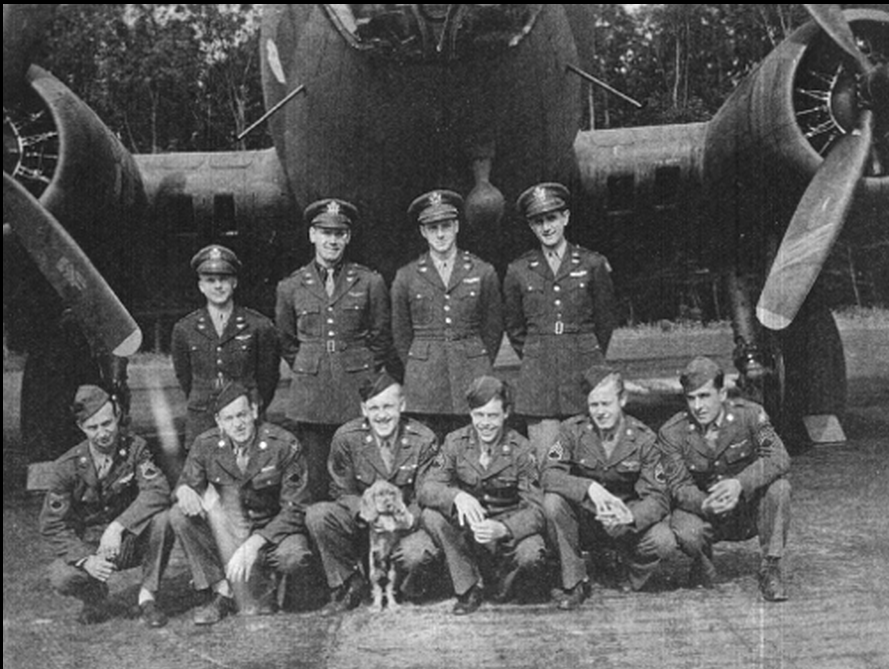
Now on the scent I started delving deeply into the Native American history of that area of Idaho and was about to contact the US government to see how I could get a copy of the air medal Melvyn Hansen had been awarded. I was convinced he was my birthfather. After all, he’d been 6’1” tall and I’m 6’3”. He was blond and so was I. We looked alike in the photos I had of him with his bomber crew. It all fit!

Technical Sergeant Melvyn E. Hansen with the crew mascot and his crew.
Back L to R: LT A. M. Blossman (B), LT J. M. Acker (CP), LT E. J. Sierens (P), LT S. J. Scousi (N)
Front L to R: SSGT G. A. Hunt (BT), TSGT H. J. Ketterman (RO), TSGT M. E. Hansen (RW), SSGT M. H. Johnson (TT), SSGT V. G. Jones (LW), SSGT L. D. Brindley (TG).
Shot down on August 12, 1943 mission to Gelsenkirchen, Germany, aboard B-17F 42-30046 “Merrie Hell” (BK*H). All crew members were KIA except for Ketterman and Brindley (POW’s).

Until … I was contacted my a third cousin on my father’s side who was a genealogist working on a couple of family trees that included the other cousins who had contacted me. I was indeed part Native American. But the tribe was Shawnee and my biological father was a man named Lacey Little McKenzie.

My mother’s nephew was perplexed and consulted his mother and the genealogist who managed his family tree. Apparently they weren’t surprised my mother had birthed the child of another man. She’d already had a daughter who was Melvyn Hansen’s, so I had a half-sister. But they never liked my mother to whom they were only related by marriage and they let my cousin know they didn’t want anything further to do with her … or me. I was an offspring non grata.

So although I know that her name was Sylvia Jan Burns, that she’d had a daughter with Melvyn Hansen and another daughter with her second husband, Richard James Fanning I’ve been cut off from any further information about her life, her death or her other children unless one of my half-sisters or their offspring follow up on our matching DNA.

BINGO! © Robert R. Feigel 2022 – All Rights Reserved
The Journey

After my mom’s reaction to my query about my birthmother I didn’t raise the subject with her again. But I did start looking into it myself after her death in 1988. By that time I had a home computer with access to the Internet via a CompuServe account and then our national telephone company ISP. Both offered fairly rudimentary Bodleian search facilities which allowed me to start my online journey.

All I had to work with is my adopted name, my adoptive parents’ names and my date and place of birth as stated on my official birth certificate.

After weeks of frustrating research I discovered some information on a State of Indiana website that took hours of wading through. At least it gave me a phone number and I decided to take the plunge. Our time zones made phoning during their business hours difficult but I was determined. Then came the phone runaround that started with a stunned receptionist asking me where New Zealand was and why was I phoning from so far away.

Bureaucracies are always challenging for an outsider. Hell, it’s challenging for the bureaucrats. Reminds me of my late-friend John Kiewit’s favorite saying: “Life is like an artichoke. You go through so much to get so little.” Basically, I was passed from one person to another until I finally got to speak to someone who gave me an address to send a letter asking the same questions I’d been repeating to each new person I was transferred to. I felt like they were playing a game called ‘Pass the Bob’.

My letter contained every bit of information I could think of and I actually sealed it with a kiss before consigning it to the Airmail slot at the central post office. It would have made a great DNA test.

By the time I finally received a response I’d been able to discover a short list of adoption search services in the USA and either phoned them or send them emails asking for further information regarding their services and costs. The costs alone were enough to make waiting for an official reply more palatable.

Basically, the official response contained pages of legalese, excerpts from Indiana State laws and a form that allowed me to request details of my adoption and the names of my birth parents “if available.” However, under their current laws the request could only be acted upon if members of my biological family had also made the same request and were searching for me.

I dutifully completed the form and sent it away and never heard anything back. I was the Lone Stranger.

Years passed and the forms were now available online. So I registered another request and got a very pleasant reply informing me that moves were afoot to liberalize the current laws to allow adoptees to request information regardless of whether or not they were already being searched for by a member of their biological family. I would be notified if and when that happened.

Then came the notification that my records had been sealed by the court and could only be opened by a new court order. Catch-22.

In the meantime, my wonderful, much loved stepdad died in California. A few months earlier I’d been able to visit him in the care facility he was in and talk to him one last time. He’d been badly treated by a live-in caregiver at the home he shared with my mom in Sun City, California and his dementia had accelerated rapidly. He was a strong, generous and caring man who’d been the main father figure for much of my life and probably the only person I knew who could remain loving a loyal while living with my mom. He was a Saint.

Several weeks after his death I received a big envelop from my “little sister” who was the only one of us still living in California. It was she on whom the care decisions regarding my stepdad rested and the only one of us who visited my mom and him an a regular basis. This wasn’t made easy since my mom disliked my sister and the feeling was mutual.

While clearing out the Sun City home (on the 9th hole of a championship golf course in a climate where you could fry eggs on the hood of your car during the day and freeze at night) my sister and her husband had found a copy of my original adoption papers. For the first time in my life I learned my pre-adoption name: “Paul Edmond Hansen.”

Online search engines had developed a lot further by then, although being conversant in Bodleian search protocols still gave me an advantage. I spent many fruitless hours searching for any information connected to that name and, after years of failure, decided to give up for awhile and focus my energies elsewhere.

I got caught up in Facebook and was able to reconnect with old friends, new friends and friends of friends. One of those was the daughter of the former girlfriend who’d started me on this journey. We’d kept in touch via email but when her emails stopped and mine bounced it was a couple of years before I learned of her death. Her daughter and I became Facebook friends and one day she asked me if I’d be willing to take a DNA test. After her mother’s death she’d discovered that the man she’d been told was her father wasn’t related and having been told about me and our relationship by her mother she was thinking there was a good chance I could be her biological father. Putting the dates together I could also see that possibility and agreed to doing the AncestryDNA test and linking it to hers.

Sadly for both of us the answer turned out to be no. But I’d made my results “public” so that anyone linked to me by their DNA results could get in touch.

The Journey © Robert R. Feigel 2022 – All Rights Reserved

Adoption

I grew up with two mothers and two fathers. My adoptive mother and step-dad and my adoptive father and stepmom. Mom and dad #1 adopted a girl who became my sister when I was three and my mom #2 already had an adopted son from her marriage to her late first husband. He became my stepbrother. Both mothers had been told they wouldn’t be able to “have babies of their own,” however both became pregnant and bore children later in life. So I also had another sister and a brother.

Even though I always called both moms mom and both dads dad when I was living with them I was under strict orders from both sets to refer to my step parents as Daddy Bob and Mother Alice. So to avoid confusion that’s what I’ll be using.

Sometime before I started kindergarten my mom sat my sister and me down, told us that we were adopted and explained what that meant. She was concerned that knowledge of my adoption would somehow filter down to my classmates and children, “being what they are” would tease me. Actually, that’s exactly what happened and I was prepared.

She explained that while the parents of other children were “stuck with what they got” we had been “chosen” and were “special.” So we were not to pay any attention to teasing from children who weren’t adopted. They were just “jealous.” Even so, it wasn’t always the other children who tried to make being adopted something to be ashamed of or justify. It could also be teachers and school officials who’d insist on getting information for their records or reports, such as what illnesses my parents and grandparents had had, etc.

Of course a lot of that comes with growing up anyway and my adoption status eventually faded into the background as I got older and more confident. It was my court imposed joint custody that caused far more difficulty and confusion. Why did Bob Feigel have a mother named, dad and sisters named Roberts? Why did I have to leave my friends in Santa Monica, California a week after school ended every year and spend the entire summer in Evansville, Indiana. Why did I have to leave my friends in Evansville for 9 months a year to go to school in California? Why did someone who went to a Lutheran Sunday School have a name that looked Jewish to some people? What kind of name was Feigel anyway? Lots of whys and whats?

It wasn’t until I’d left home (both homes) and was living with a girlfriend that the yearning to know about my biological family was awakened. Ironically, it was the girlfriend whose daughter asked me to get a DNA test decades later who initiated the journey. Just as a matter of curiosity one day she’d asked if I ever wondered who my birth parents were.

The question grew from there and one day after being at my mom and stepdad’s for dinner I broached the subject by asking her if she knew what my birthmother had died of. I put the question that way because in thinking of a way to introduce the subject it occurred to me that asking the same kind of question the school authorities asked for health reasons would preclude any suggestion that I was unhappy with my adoption. Or something like that.

My mom was a very sharp, complex person who was also an alcoholic and easily offended. It was clear my question was unexpected, but that she had prepared for the eventuality that one day I’d ask. Her answer stunned me. “What makes you think she’s dead?”

Having lived my life believing what I’d been told about being “chosen and special” I’d always assumed that the only reason anyone would give up someone as special as me would be death. I could see that she was trying not to laugh so I started laughing at myself for her. What an amazing conceit! Vanities of vanities … thy name is “special.”

Once the moment had passed, I ventured, “You mean she’s still living?”

The chill was palpable. “You’ve known about your adoption since you were a child.” she replied curtly. “What’s happened to make you suddenly want to know about your birthmother? What is going on with you?”

Oh no! I needed to put a lid on this quickly before it escalated into a meltdown. “No … I was simply asked the question by someone and just curious.”

Her next comment put an end to the conversation and left me with an irony I’ll go into more fully when I describe the life of my legendary Shawnee ancestor, Chief Waweyapiersenwaw Bluejacket.

“Beware of what you wish for, you might find out your grandfather was a horse thief.” Turns out that that my 5x grandfather was a very successful horse thief. So did my mom know a lot more about my biological family than the records show?

Adoption © Robert R. Feigel 2022 – All Rights Reserved

About

A brief bio might help put some things in perspective.

The ME part …

I was born in Evansville Indiana in December 1941 and adopted by my mom and dad. They didn’t get along and not long after my first birthday my mom took me with her to Florida where we lived during WWII.

A court order during divorce proceedings meant that I spent summers in Evansville with my dad and his new family, and the 9 months my school year with my mom and her new family (“until 21, self-supporting or married”).

In today’s world you could say that I was a product of white privilege with a capital P. I make no apologies and acknowledge the advantages.

Thanks to a job at a local supermarket in Santa Monica, CA, I became “self-supporting” when I was 16 and by 17 was finally able to spend all year in Southern California surfing beaches up and down the coast.

After a year at Santa Monica City College and two semesters at Evansville College I decided to give up on tertiary education to continue my Endless Summers on the coast. Several jobs and adventures later I got a job with a surfing magazine and started writing.

From then on my life became neverending cycle of new jobs, adventures and one last attempt at college.

I’ve lived and worked on Maui and O’ahu, Hawai’i, in Costa Rica and in Aotearoa New Zealand where I’ve lived since 1974.

Before I semi-retired in 2001 aged 60 I worked for a radio station and then as the creative director of a couple of advertising agencies in Auckland. Just before my 50th birthday I resigned and started my own, independent creative consultancy and wondered why I hadn’t made the move years earlier.

After I semi-retired I finally got the opportunity to do what I was always hoping to do and that is write human interest articles and features for lifestyle magazines. It was a wonderful period.

For the past few years I’ve been at a bit of a loss and not able to figure out why. I needed to write again, but couldn’t quite find the direction. So close, but not close enough. I was spending far too much time trying to find it on Facebook and wasting my energies and time over issues that don’t matter to me any more.

One day I was reading a blog I found interesting and wondered if that wasn’t a direction I could explore. I didn’t want to climb the steep, slippery learning curve of creating another website. Besides, the software I’d used for my surfwriter.net site was outdated by decades. WordPress to the rescue.

So … here we are. YOU and ME and my keyboard. Giddyup!

About © Robert R. Feigel 2022 – All Rights Reserved