Surfwriter.net is the website I launched in February 2002. I was hoping to entertain a few web-surfers and re-establish contact with some of the old crew from my surfing days. Over the years, the site has welcomed millions of visitors and not only did I get back in touch with several of my old mates, I’ve met some exceptional people and made some new friends along the way.
While the web authoring software I used 20 years ago was perfect for the use I put it to back then, it has produced a site that is way out of date on several levels. So I’ll be migrating parts of that site back to this site over the next several weeks so I can rebuild it with a more modern format.
This is going to be a major challenge because I wanted to make the layout of my old site look like a 60s surfing magazine. And I think I succeeded. It’s going to take some effort and learning on my part to achieve this. So please bear with me.
I’ve already added my ‘Kidnap in Oaxaca’ story in my ‘Adventures’ section and I’ll be making some changes to the ‘Pieces’ menu to accommodate the new material.
In the meantime, click on the surfwriter.net link to go to the old site. I’ll keep the URL but I’m not sure if I’ll continue to maintain the account because the people at GoDaddy keep raising their prices.
When I turned 18 I got a letter from the government informing me that I was to report for my obligatory draft physical at a building that was, from memory, somewhere in West Los Angeles .
I arrived feeling confident that I’d pass my physical and then I’d have to decided which service to join. Probably the US Navy since that’s what my stepdad had served in during WWII and I like the idea of being near or on the ocean rather than landlocked somewhere. The likelihood of going to Viet Nam was quite real and I reasoned that it was my duty.
I’d followed the American involvement in the war since I first read about it in LIFE Magazine and TIME Magazine. Based on that superficial information I accepted the position that it was this American’s duty to defend Viet Nam from being taken over by Communist China.
Before this my only experience of regimentation had been school gym, swimming, water polo and football teams and summer camp. I was unused to not being treated like an individual or being ordered around by strangers. It was a foreign experience about to become even more alien.
As ordered I arrived at the building, parked my car and joined the parade of guys my age entering the building and following the signs directing us to go up the stairs to the next floor.
From that point on all of us were being ordered around as if we were already conscripts and told to stand in what turned out to be a sort of lopsided circle in a large room with wooden floors. Along one side of where we were standing was several trestle tables. Behind the tables sat men in uniform and a couple of men in white coats like doctors. The men who ordered us around stood at the sides of these tables and moved around quite a bit. They all wore uniforms and were quite stern.
One of these men explained what would be expected of us during our time there and warned us not to question anything or talk back. We were to follow orders and it would be best for everyone if we did.
We’d already filled out forms on clipboards and handed them to the uniformed men who gathered them from each of us. Now it was time for the part everyone had warned me about. The strip and poke.
As we stood around with our underwear dropped around our feet I noticed that quite a few of my fellow nudists were staring at a guy across from me with the biggest cock I’ve ever seen. The guy seemed quite pleased with all the attention and I couldn’t help but notice that this was the only noticeable thing about him. He was fat and had a face like a pudding. But his cock was quite large and hung down nearly halfway to his knees.
Except for a thermometer and the odd enema when I was a kid I’d never had anything shoved up my ass. My experience in Junior High School when a bully goosed me while I was going up some stairs was painful enough, but not as painful for him after I punched him in the forehead so he fell backwards down the stairs to the next landing and carried a large knot on his forehead for weeks. But I think the white coated guy who examined me was looking for hernias and I don’t remember him doing anything like the prostate exam I was to have decades later.
So there I am, still standing more or less naked in a room full of naked males when one of the people sitting behind one of the long tables jumps up, shouts, “Hold it!” Points at me, shouts, “You there. Don’t move.” He scoots across the table and rushes out to grab my left hand and hold it up by my index finger.
“What’s this,” he demands. “This finger. What’s the story/” It took me a moment to regain my composure. I explain that my finger was severed in an accident when I was three and reattached. It grew back crooked and stunted and has been this way ever since I could remember.
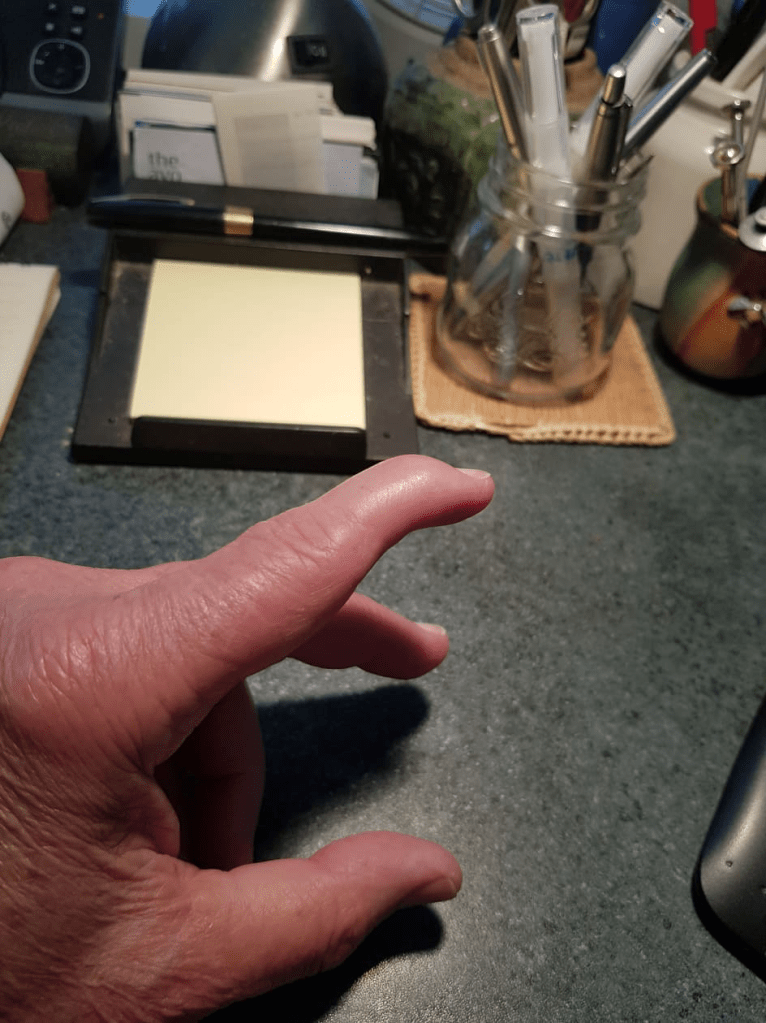
My secondary Trigger Finger!
He scrutinized my finger carefully and asked if I had any feeling it it. I told him yes and that holding like that hurt. So he gently returned my hand, thanked me and returned to the table where he started writing on what I assumed was my clipboard form.
We quickly pulled up our underwear (it amazed me that so many guys wore boxer shorts instead of my y-fronts) and were told to get back into our “street clothes.” Then we were ushered into another room that looked like a classroom where we sat a desks and filled in more forms.
These questions are far more personal. Many were about things I’d never been asked about before. I wondered why they wanted to know.
Again the forms were gathered up and we waited while we were called in for one-to-one interviews. Finally I was put in a room with a bland sort of man who told me there would be no more tests for me because I’d failed the physical. Failed? After surfing regularly since I was 16 I was strong, fit and had no infirmities. I was told they’d probably notice the “surfing knots” (calcium deposits) on the tops of my feet and on my knees caused by paddling my surfboard while propped up on my knees. But no one had said a word about them. I was well muscled and had a massive lung capacity. Why did I fail?
“It’s your trigger finger,” he explained, glancing disdainfully at the index finger of my left hand like it might be catching. I tried to hide it. “But I’m right handed,” I said. And then, without any change of expression to indicate he was joking, “But what if your right arm gets blown off?” And that was that.
While just about everyone else stayed on I was told I could go (in other words, go) and walked down the stairs in into the building lobby where there was a middle aged lady standing at a kiosk with coffee and donuts courtesy of the USO.
The lady offered me some coffee and my choice from some rather stale, manky looking donuts. “Don’t worry honey,” she said. “It’s nothing to be ashamed of.”
After sipping the weak coffee on the way out to my car I was starting to feel anything but ashamed. I was feeling good. GREAT! I’d just been saved from having my life regimented and controlled by more people like those I’d been dealing with upstairs.
Weeks later I received a letter containing my draft card with my 1-Y classification. I wasn’t exactly “unfit” for military service but I would only be called up as a last resort. But, it left one important question unanswered.
Could I still pull a trigger if my right arm was blown off?
When I was 15 my stepmother accepted the dubious job of teaching me how to drive. Her car was an old, stick-shift Ford and the last Ford bought by my Evansville family.
My dyslexia made certain basic perceptions different for me. Even today, I can’t use mirrors to backup the car and trying to remove a hair or medicate a spot on my face means I have to force one hand to move to the spot with my other hand.
Determining right from left has been made possible by me translating left as the side with my bent finger, leaving the other side as right.
Mother Alice started out by driving me to some quiet rural roads, but I’d stall the car so often that she decided to try a place where there was very little traffic.
She chose a local cemetery with narrow lanes and graves to remind me what could happen if I didn’t drive safely. A win-win.
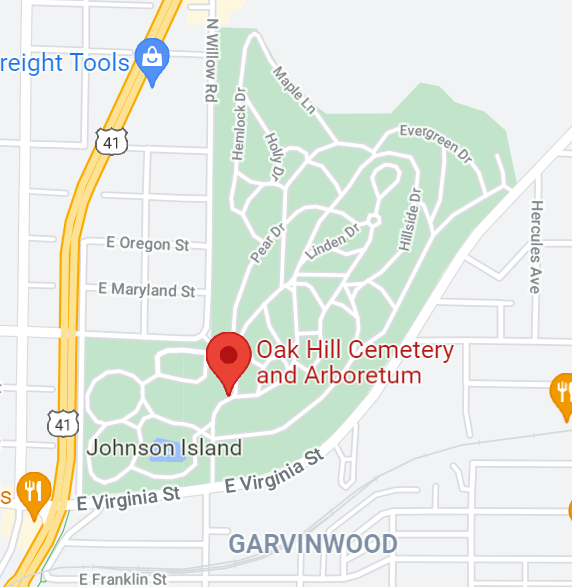
Oakhill Cemetery, Evansville IN
She’d drive us from home to the cemetery and we’d swap places. I was a big kid by that time. Over six feet tall with long legs. So I could reach the pedals, handle the unpowered steering wheel and shift gears. What I couldn’t get into my head was how to use the clutch and shift gears. I couldn’t coordinate the movements.
We tried and tried and tried. I just couldn’t get the sequence right. Then, one day I had a small success. I shifted from neutral into first an off we lurched and lurched and lurched like one of those bucking bull machines until I stalled yet again.
Her capacity for patience was amazing. I’m sure my dad would have been yelling at me by this point. I just couldn’t get it.
I don’t know how she knew about these things. She was so wise about so much. She told me that the secret to learning how to shift gears and drive was repetition. “Just keep working on it and one day it will suddenly come to you.”
And she was right. One day I started off smoothly in first from a standstill and shifted into second. The winding lanes weren’t designed for third gear and she said we’d try that later on a street in town. But at least I’d gotten over the first hurdle.
UNTIL … until I turned into one of the narrow lanes that would take us to the exit/entrance. After weeks of no traffic I was suddenly faced with a big, long hearse followed by a limousine followed by a cortege of cars that snaked off into the distance. I panicked, slammed on the breaks and stalled right in front of the hearse.
In the hearse the two men in black waved at me to get out of the way. I had to restart the car and try to get into a gear I hadn’t tried before. Reverse was beyond me. I stalled and stalled. One of the men in black got out and stood there in the lane waving his arms around as if that would help. I looked over at Mother Alice and found that she had her hand over her mouth. At first I thought she was crying but she was trying to stifle a laugh. She failed and was laughing out loud as the man in black threw up his hands in disgust and walked away to speak to the cortege.
Mother Alice managed to tell me that we’d better swap places and backed up the lane, parking off to the side in order to let the funeral cortege carry on. I turned away from the passenger window and Mother Alice managed to focus her attention on the bench seat between us while she continued to laugh.
Finally, I saw the humor in what just happened and we laughed all the way home although we never mentioned any of this to my dad.
When I moved to my little cottage in Kihei, Maui it was next door to a bigger house occupied by Helen Peters, a granddaughter and two grandsons. In fact, my place used to be the kitchen for the main house.
It took awhile for us to be introduced because Helen worked days and I worked afternoons and nights.
Once we started getting to know one another it was clear that I was a stranger in a very strange land. I had my Haole mainland ways of doing things and they were locals to the core. As a result it took awhile for me to relax into their ways.
The first major breakthrough occurred when Auntie Helen brought over some poi for me to try. I’d had some poi in a local cafe but it was nothing like this. This was “sour poi” – a fermented paste of taro root. The taro is pounded until the fibers are broken down while water is added. Freshly made it’s sweet. But left to ferment it becomes sour and is sometimes called “Hawaiian yogurt.” It’s great for digestion.
She told me her favorite was “three finger poi” or poi at a consistency that needed three fingers to scoop it up. I told her that would be my favorite as well and she gave me a bowl of it from the bucket she’d let it ferment in. I scarfed the lot.
We did favors for each other. Sometimes it was a ride somewhere as Helen didn’t have a car and I don’t know if she drove. She’d made dishes for her family and send one of the grandkids over with some for me. It became my introduction to local food. One day I was at “Azeka Store” when she came in. The store set prices according to who you were. A “local” got a much lower price than a tourist and a tourist got a higher prices than “kamaiana” – or people who, by virtue of living locally were accepted by the locals to be as close to a local you could be without having been island born. The person at the counter asked me if I was kamaiana and while I was thinking about how to answer, Helen barked “KAMAIANA!” From then on I got a lower price. But that was after I’d lived there for over a year.
I worked as a waiter at the Ka’anapali Hilton near Lahaina. So much of my eating was done in Haole establishments – although having seen some of what went on in the restaurant kitchen I didn’t eat the free food for staff. My regular diet was pretty light. I’d stopped eating red meat before I left the mainland. But I did eat fish and one of my favorite haunts on a night off was the garden bar behind the old Pioneer Inn in Lahaina. Their salad bar was the best on the island and I could buy a big piece of Mahimahi wrapped in tin-foil with a knob of butter, plus a baked potato wrapped the same PLUS the all I could eat salad bar, including sour cream for the potato – all for five dollars. That was usually the minimum tip I’d get from a table of two in the “silver service” Lokilani restaurant and my average take per night was $40. So no big thing when rent was $25 a month.
I was getting along well at the restaurant. The maître ‘d had mentored me well and talked the Hilton management into sponsoring me for further training at their school in Switzerland. The hotel management was extremely supportive and friendly, except for the head chef “Chef Robert” – pronounced the French way. But then he was as mad as a meat-axe and didn’t get along with anybody. I once witnessed him chase a busboy around the kitchen with a carving knife, yelling like a madman.
When I learned that Helen’s favorite singer, Don Ho, was scheduled to perform at the hotel I bought three tickets. One for Helen, one for an old friend of hers and one for her granddaughter.
To make the evening even more special I ordered a lei from the flower shop to be waiting for each of them on their arrival. It was to be a girl’s night out and I was happy not to be going. I love Hawai’ian music, and still do, but not Don Ho’s lounge-style.
When I ordered the leis I asked the couple who owned the concession for their advice. The older ladies should have multi-strand plumeria leis, but the granddaughter, who was much younger, should have a seven strand lei make of fragrant pikake flowers. What I didn’t know was that my giving the granddaughter that particular lei – especially witnessed by her grandmother – was tantamount to asking for her hand in marriage.
The next few weeks were a flurry of activity. The granddaughter would arrive at my door with plates of food and other small gifts. It was clear she wasn’t doing these things willingly. She’d never been friendly to me before now and the new smile pasted on her face was scary. Like a tiki at a blood sacrifice. But even though I didn’t have a clue what was going on, the die was cast.
Suddenly I was taken in tow by various uncles and cousins and introduced to family throughout the island. One of the strangest was being taken up the side of Haleakala (the volcano under which we lived) and not only introduced to a cousin or uncle who had a pig farm, but introduced to each of his prize animals. As if I knew the difference, I was told about their pedigree, their breeding and their weight.
The culmination of this manic, non-stop meet and greet saga was my first real Hawai’ian luau. Helen had been introducing me to some traditional songs. She and her friends had a singalong in the area outside of my windows one night and those beautiful harmonies lulled me into one of the most peaceful sleeps I’ve ever had.
She also started using Hawai’ian more often when speaking to me, and speaking only Hawai’ian to locals when I was around.
Moving from Malibu to Maui was far more significant than I expected. I was looking for a change of lifestyle, but was greeted with a change of life. It was like going from Ozzie and Harriet to the Twilight Zone. Nothing would ever be the same again and I never knew what major lesson I’d be taught next.
After becoming immersed in the practice of Kriya Yoga and joining the Self-Realization Fellowship, I was meditating every morning before walking from my place in Kihei, (“one mile mauka Azeka Store”) to the beach for a swim. From memory the distance was about 3/4 of a mile each way and I’d practice my breathing exercises there and back.
One morning during meditation I became aware of a message. It was crystal clear and I couldn’t ignore it. “Your guru is arriving at the airport in Kahului. Go now!”
Instead of my walk I got on my little Kawasaki 125 dirtbike and rode like the wind.
When I got there the stall holders and lei teams were just setting up for the first arrival of the day. To make sure I wouldn’t miss my guru I went up on the mezzanine so I could see every arrival.
I’d already decided I knew what my guru would look like and what I’d do when he stepped into the arrival lounge. He’d be wearing robes (your basic guru uniform) and have a long white beard. I’d rush down to the lounge and throw myself on the floor at his feet and declare my total devotion.
The first flight arrived and so did the arrivals. Maybe forty or fifty people. The official welcome teams placed leis on necks and the souvenir sellers sold to a few others . I searched every face and there was nobody who fit my description.
More flights arrived and it was the exact same scenario with different people. Then the stalls closed down and welcoming teams gathered up their remaining leis and left. Those were the flights for that morning and they wouldn’t resume for several hours.
I was stunned. I sat on the mezzanine stairs in the empty airport wondering what I’d done wrong. Then that crystal clear message came through again. “You have met your guru and didn’t recognize them. Everyone you meet in life is your guru. You learn from everyone.”
I rode back to my shack behind the abandoned mango orchard feeling both liberated and disappointed. I was looking forward to a life as an ascetic, dedicating myself to meditation and virtue. I saw myself wearing robes and walking around with a long beard spouting words of wisdom. Damn! I was going to be stuck being myself!
Well I was still digesting that lesson while nursing a drink on the downstairs veranda at the Pioneer Inn in Lahaina wen an interesting looking individual sat down across from me and started talking. He introduced himself as “Shogo” and told me he was there to teach me my next lesson.
I explained that I was just getting ready to head home to Kihei and invited him to join me. I explained that I didn’t have much to offer him to eat, but I was planning to have some brown rice and a small salad for dinner. He said it sounded perfect.
At the time I was looking after and old panel truck once used to transport workers to and from the cane fields. The rear had two wood benches along each side and windows with grills for ventilation. It was a monster to drive and a real fuel guzzler. But I drove it on occasion just to keep the battery charged.
The noise in the truck made it difficult to carry on a conversation so we’d sunk into silence as we drove along Honoapiilani Highway towards Olowalu when he suddenly asked, “How is your mother? How is her back/”
That sent chills down my back because I hadn’t mentioned my mother’s back surgery to anyone on the island. In fact, the only people who knew about it was my family on the mainland.
We were passing the steep valley going up from Olowalu to the Iao Valley lookout when he pointed up the valley and said, “That is where the eagles fly. That is where you fly with the eagles.”
And at that moment I left my body.
If you’ve ever experienced what I’m talking about you know it’s true. If not then there’s little point in trying to convince you. My awareness, my being my entire consciousness was suddenly above the cabin of the truck and experiencing total vision that encompassed everything. Like being a living bubble. My body was still sitting in the truck with Shogo, but the rest of me was somehow hovering above the truck, tanking the whole thing in.
Suddenly I became aware of some oncoming vehicles and found myself back in my body just as the question formed, “Who is driving?”
Shogo was sitting there with a knowing smile on his face and not a word was spoken.
I was still shaken when we arrived at my place and was able to calm myself by preparing the modest meal while Shogo sat in a lotus position on the tatami humming quietly to himself.
After dinner I sat across from him on one of the mattresses that served as sofas and beds. Shogo leaned over and said, “Carrying so many faces is tiring. You only need your own face from now on.” And when he placed his hand on my forehead I literally felt my faces slip away.
By my faces, Shogo meant the personas I’d been using since childhood to mask my true feelings. The masks I put on for other people. The face I used to please people or to mislead them. The masks I used so people would like me. They were all slipping away and I was left feeling many times lighter. A huge burden had melted away.
Shogo smiled and said, “Whenever you think of me, I’ll be there. But I’ll always be someone else. Now it’s time for you to rest.”
Again he placed his hand on my forehead and I fell asleep. The next morning when I woke Shogo was gone and there was no sign he’d ever been there.
Months later I was stopped in my car (the truck had gone back to its owner) when a bus carrying prisoners went by and I spotted Shogo sitting at a window. He was dressed in a prison jumpsuit. He smiled, waved and turned away. He was someone else now.
One of the most valuable things I learned in school was how to type. It was by accident really. In junior high they had classes called “elective” that were supposed to teach you skills suitable to your gender. For boys the elective classes were also called “workshop.” I’d been assigned to woodworking which taught me how to pound in nails, saw a board and screw a screw. I can’t remember what project I brought home at the end of it, but it must have been unmemorable.
The second class was something to do with electricity taught by an aptly named, Mr Savage. His idea of a great way to introduce the subject was to have the all male class stand in a circle holding hands while the two boys at either end held onto electric cables attached to a hand operated generator while Mr Savage turned the crank. What Mr Savage didn’t know and probably would have enjoyed is that, as a young child I’d stuck one of my mother’s bobby-pins into a wall socket and got thrown across the room where I landed on a sofa. Mr Savage’s little demonstration left me shaken to the core.
Next I was assigned the “Mechanical Drawing” class. I was enjoying the class immensely until I discovered the new electric pencil sharpener and managed to use up an entire semester’s allocation of pencils trying to get the “perfect point.”
The school had to put me somewhere and since none of the other workshop teachers was willing to take me on and everything else was already filled I became the only male in the typing class taught by a pert woman who always wore suit. I think her name was Mrs Perez or something similar.
My mom was pleased because she thought that typing would be beneficial in strengthening the index finger of my left hand. It had been severed in an accident when I was three and reattached by a young doctor who’d returned from a field hospital in WWII with newly acquired skills in microsurgery. Because the more traditional doctors didn’t think his new surgical methods would work and were dismissive when they did, I was never afforded the kind of targeted physical therapy that would have helped the tendons, ligaments and muscles to develop. The finger remained stunted, bent and stiff.
My finger today.
To everyone’s surprise I became quite a good typist. Second fastest (based on speed and accuracy) in the class. Of course that was on a big, old Underwood that remained in the class.
My mom and stepdad bought a smaller model for me to use at home and I used that to type out all my school assignments from then on.
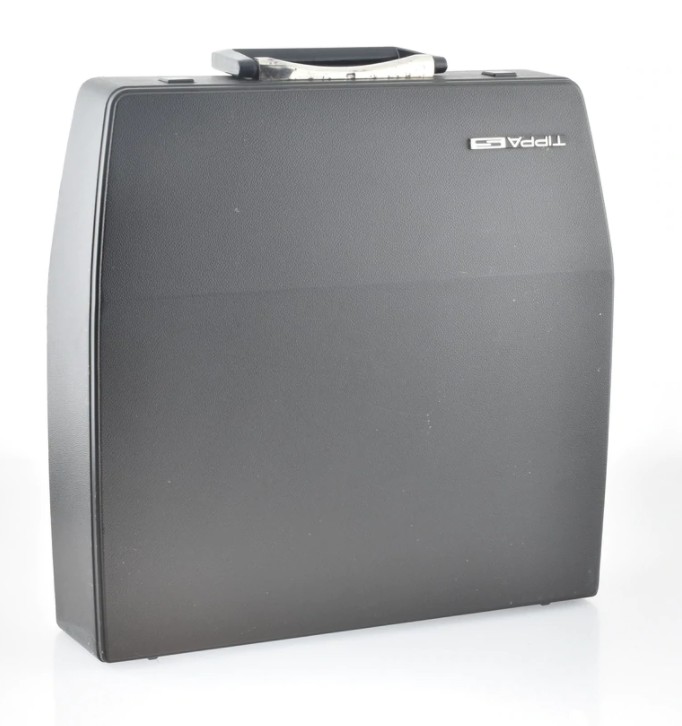
Years later when I started writing for a surfing magazine I used the typewriter in the office until my pal, editor and mentor, Bill Cleary, gave me his small Alder Tippa. He’d bought a new model and I used my new portable to write my monthly ‘Feigel Fables’. After being attracted a new Tippa model with a sans serif typeface in typewriter shop I’d taken it to for servicing, I traded it in for the new one.
It has accompanied me to the UK, Ireland, Hawaii, New Zealand and through Mexico, Central America and South America.
I haven’t used it in years and doubt my keyboard weakened fingers are up to using it now. But I still have it and I’ll never part with it.
I remember the joy of using my first electric typewriter. It was an IBM Selectric in the offices of Young American Research Institute (YARI) in Santa Monica where I was assistant editor of company’s monthly newsletter, the Young American Report (YAR). Subscribers included Fortune’s 500 and included all the major media networks and companies like Pepsi, Coca Cola and Dick Clark Enterprises, etc.
Our secretary had exclusive use of the IBM unless she wanted to “pop out” of the office and asked me to “cover the phone.” I’d use her machine to type personal letters using the different font balls for effect.
Of course the machine was far too heavy to tote around so I’d only use it for fun.
All my celebrity interview articles were typed on my Tippa and so where all the scripts and articles I wrote after breaking into the New Zealand market.
I was working for one of NZ’s major corporations, Progressive Enterprises, when my fingers experienced their next treat. The company owned and operated a chain of supermarkets (Foodtown), a chain of fast food outlets (Georgie Pie) and an early data processing company. Editing the company’s monthly staff magazine was a part-time job and I used the Tippa with the text being taken to an independent typesetter. But they offered me an additional job of operating the advertising department’s new computerized typesetting machine to produce camera ready headlines and copy for the company’s newspaper “specials” ads.
Once the freelance income from articles and scripts became more lucrative I quit those jobs. But not before gaining some skills I didn’t have before. One of the young guys who worked in the data processing department (a sealed suite of offices with floor to ceiling computer banks excreting miles of perforated tapes) got to be a family friend and when I left the company we kept in touch.
He introduced me to my first PC at an Apple demonstration show in Auckland. I liked the idea, but couldn’t afford to buy one. Instead, I bought a word processor made by Panasonic that saved my data onto a floppy disc and let me copy and paste, etc.
From there I got a job as senior copywriter at a radio station in Auckland. My job was to write and produce radio commercials and it came with an electric typewriter. So again, my fingers were allowed to rest. I used the word processor at home and the electric typewriter at work.
When we moved to Waiheke Island near Auckland the radio station refused to let me adjust my hours to accommodate the ferry commute from the island to the CBD. I resigned.
It was a big wrench. I love radio and I loved working at the station. My workmates were family and I missed the daily excitement, challenges and dramas. I missed my radio family. My office was right across from the newsroom and there was always something going on. I’d also miss the regular pay.
It didn’t take all that long for me to get another job. This time working for an advertising agency.as their “creative director.” The radio station had helped me learn how to produce commercials, pick sound effects and music, and direct the voice actors, etc. But it took a few tries before I learned how to communicate my creative “visions” to an art director who’d carry through that vision. Fortunately, I worked with several who’d tweak my ideas and, together, we’d come up with an even better result.
The same applied to television commercials and corporate videos. I learned that being a creative director meant embracing collaboration and teamwork. I loved it
During that period I’d gone from using a word processor to using a computer. The industry standard for “design oriented” or “art oriented” creative directors was a MAC. But I was a “copy oriented” ‘CD’ and Apple hadn’t (and still hasn’t) designed wordprocessing software that is anywhere near as good as what I’d stumbled upon.
I’d started on a Windows PC using the earliest version of Windows. The monitor was black with a green readout and I had to use a code book to operate it. That wasn’t a problem because the phototypesetter back in my Progressive Enterprise days had two code books each the size of NYC telephone books and I’d ended up writing code that was better.
No … the problem was that it wouldn’t let me see the what I’d written in a way I could relate to. It was flat, unattractive and dull.
So when Windows updated there ‘OS” and allowed for new software to be introduced I celebrated. I have never like Word for Windows. For some reason Microsoft screws up everything it touches. For reasons of pure greed they introduce new versions of Windows’ operating systems without perfecting them first and we, the users, are left with having to get endless “updates” to help them fix the problems they foisted in us.
Some of those updates cause even more problems than they solved and users are left to spend their time trying to figure out how to undo the problems Microsoft has caused. For example, hundreds of thousands of printers no longer worked with Windows systems after an update and it took weeks before Microsoft acknowledged the problem and provided a solution.
The software that opened the door to my personal creative process was LOTUS Ami Pro. Unlike the clunky, user-unfriendly POS Microsoft WORD, Ami Pro was full of features that made it possible for me to easily and intuitively design a document with text (fonts, headlines, etc.) and images. It was truly a WYSIWYG extravaganza that an anal retentive bureaucracy like Microsoft could never achieve … and still hasn’t.
Unfortunately, Microsoft used its corporate clout and monopoly to make its own crappy software the document standard and the far superior Lotus Ami Pro, Lotus Word Pro and Word Perfect disappeared.
I still refuse to use Windows Word to this day and use other software that emulates it while being easier to use.
Today I see the cyst that formed on a knuckle of my right hand has become less swollen and painful. Typing, even on my current Logitech keyboard, is not taxing. But it can strain what are becoming arthritic 80 year old+ hands. I didn’t have any idea where this was going when I started it earlier today and have no idea where to put it. But I hope you enjoyed it.
Mid-60s and I was interviewing a lot of music people and television people for various magazines in Hollywood. I started out interviewing Sonny & Cher and we became friends during that period. The Byrds were a challenge, but I interviewed them at the request of their agent, Derik Taylor (formerly the Beatles publicity manager). Barry McGuire, The Turtles, Leaves, Love, the Grass Roots, Gary and the Playboys, David MacCullum, Peter Falk, the horrible little punk who fronted the Hermits, Mister ED and the cast, and so on. But not the Beatles (who were in a different league. And not the Stones, whose manager refused to answer my calls or return them.
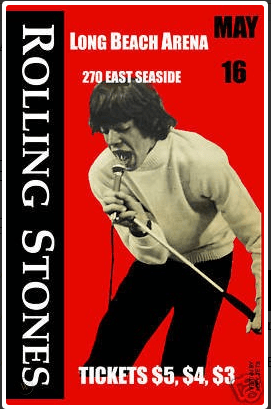
However, I was granted a press pass of one for their concerts. It was to be held in an indoor sports arena in Long Beach and I rode down in a smoke filled car with several friends who had tickets.
From memory the stadium was set up for basketball with auditorium seating going up each side and a low stage at one end where one of the baskets would be. The seating above the stage was empty with maybe two guards on each side of the section to keep out anyone wanting to sit above the stage.
Once we were admitted my press pass let me cruise around the place getting a feel for the audience and the venue. So I was able to observe what happened rather than be part of it when the proverbial hit the proverbial shortly after the concert started.
The atmosphere was tense from the beginning. Like a martial arts competition waiting for the first blood to be spilled. My smoke induced mellowness gave way to a wariness that had all my senses on alert.
As the Stones emerged from a the team corridor under the seating to the left of the stage the applause and cheers took over. They slowly came up the stairs to the stage and started to settle in to what was a very basic setting for a band of their stature. The audience was starting to get restless again. The Stones could hardly make a dramatic entrance on a stage like that.
All these years later I can’t remember the exact sequence of events, but I think the Stones had had finished their final sound check and were just about to start their first set when a couple of young girls ran across the empty seats above the stage. But the guards couldn’t move as quickly as the girls who’d surprised them.
While one girl was cornered and caught the other manged to climb over seats past the guards and down to front row railing. She hung there like a rag doll while the audience erupted in shouts to “JUMP!” and she dropped awkwardly onto the stage to the side of where Charlie Watts was sitting behind his drums. The Stones were also surprised and slow to react. Charlie had just taken off his suede jacket and carefully draped it over the back of a nearby folding chair. The girl, who’d obviously injured her leg, hopped over, grabbed his jacket, put her face in it and waved it around like a trophy. By that time the stage security got their act together and grabbed the girl she’d dropped the jacket on the floor. Then she was manhandled off the stage to the boos, cheers and jeers of the audience.
Charlie picked up his jacket, held it up and looked at it with disgust as if it now carried a communicable disease. He threw it back towards the folding chair and where it landed again on the stage.
At this point a policeman came up onto the stage and made matters worse. He warned the audience that if they didn’t calm down he’d close down the concert. That led to more booing and Mick took the microphone from the policeman and pleaded for calm. But he ended it by criticizing the policeman’s interference and said something else I couldn’t hear. Whatever it was it made the policeman angry. He countered by taking back the microphone and saying that the concert was now over and everyone should leave peacefully or they’d be arrested. So much for any crowd control skills.
As an observer I couldn’t believe how quickly things got out of control. The audience became a mob. Shouts and threats filled the arena. The police ushered the Rolling Stones off the stage and back into the corridor I was standing next to. I was able to follow them down the corridor to the side of the auditorium. Later I discovered that the doors we were passing led to team dressing rooms, etc.
By the time I got out the back doors and out in the sunlight I found myself close to a field and track. The Stones were being hustled across the field to a helicopter. The blades were already in motion and the Stones had to duck their heads as they ran. Once they were in it immediately took off.
Right in front of the doors was a long, black, stretch limo with tinted windows. Before I could process the helicopter and the limo a screaming mob of what had once been an expectant audience rounded the building and converged on the limo.
Clearly, the Long Beach police hadn’t been prepared for any of this and whoever it was who got up on stage had been inept. While a crowd surrounded the limousine assuming that the Stones were inside, the police started hitting out indiscriminately with their clubs. Meanwhile, as the helicopter banked away from the melee, a motorcycle officer on his big Harley put down his bike and skidded down a street up the hill causing sparks to fly. I was witnessing a real-life fiasco.
I’d only been in another riot once before and that was very short lived. It after a 3I League football game between my high school (Santa Monica High) and I think it was Torrance. It was a grudge match and the post-game testosterone spilled over into the street outside the Corsair Stadium at Santa Monica City College. It got a bit bloody but nothing like this.
A beautiful girl I’d noticed before in the audience had managed to climb up and onto the limo roof and was crawling along the top when a policeman on the hood hit her with his club and split her scalp. I got splattered with her blood as I got pushed back even further by the heaving mob.
The police were panicking and clearly out of their depth. The crowd was berserk. I wondered how long it would be before the mob realized that the Stones were gone. What starts out as an audience can so easily turn into a mob and I never want to experience this again. It was a mess and the reason I still avoid crowds to this day.
But about Charlie Watts. After rubbing her face in it and waving it around the silly girl who caused all this dropped his jacket on the stage where he picked it up, looked it over and tossed it back onto the stage as if it had been spoiled. In a very real way it had. What started out as a Rolling Stones performance ended up as a riot thanks to an immature fan who probably still doesn’t realize the mayhem she caused back then. But I’ll always remember the look of absolute disgust on Charlie Watt’s face as he took the jacket he’d obviously treasured and discarded it on the crappy Long Beach stage of the concert that had been denied him, the Stones and their audience.
Postscript: Later, I heard that the girl who’d climbed over the railing and dropped to the stage had broken her leg. Whether that’s true or not is another thing, but I was always surprised that news of the failed concert and the riot were not mention in the mainstream media. As for me writing about it at the time, I simply wanted to forget about it … and nearly did until someone asked me why I was so adverse to going to rock concerts when I used to interview some of the acts.
While I’ve done interviews that I enjoyed more than others the absolute worst one I conducted was with Peter Noone of Herman and his Hermits.
It was a strange assignment from the start. I was to go to the studio where the popular television show ‘Mister Ed’ was shot and interview the main cast members. After that I could interview Peter Noone.
What made it strange was that I received a list of questions given to the magazine by the show’s producers. I could ask some of my own questions but I was required to ask the scripted questions as well.
OK. I could live with that because I was looking forward to meeting Alan Young and Connie Hines and one of my favorite actors, Leon Ames. As it turned out Leon Ames was ill or otherwise engaged and I interviewed Alan, Connie, the voice of Mister Ed (Allan Lane), Mister Ed himself and his trainer, Les Wilson.
The scripted questions were for Mister Ed with the answers read from a script by Allan Lane. It was all quite surreal.
Mister Ed and some Pommy Git.
It seems that Derek Taylor was representing Herman and His Hermits and had arranged for an article supplied by him about their visit to the Mister Ed set to appear in an issue of KRLA BEAT.
As often happens in the business the “I’ll scratch your back” was for the show’s producer, Arthur Lubin. The show’s ratings were starting to slip and Mr Lubin wanted an article just about the show and the Peter Noone interview was “if you scratch mine.”
The interview with the cast went well and was a lot of fun. The set was surpsingly compact for what they were able to get out of it on the show and I learned a lot about how the trainer made it appear that Mister Ed was moving his lips. Actually, he DID move his lips to his trainer’s cues and, from memory, Vaseline.
Then came the time for me to interview Peter Noone. To be honest I didn’t like the music produced by Herman and His Hermits. I thought of it as novelty music and not very good novelty music at that. Too cute. Too superficial and lollypop … or bubblegum. Take your pick.
I’d seen them on television and didn’t like Peter’s Herman act either. Far too swarmy. I wasn’t looking forward to meeting him but wasn’t about to show it.
As it turns out, the feeling was mutual. Peter made it clear that the interview in Arthur Lubins overstuffed office was an imposition and that he was far too important for yet another interview.
But I had my assignment and decieded to be as cordial and professional as I could, ask the questions I’d prepared and look fascinated by the anwers.
I’m 6’3″. Peter isn’t. He didn’t bother to get up and shake my hand. Instead he parked himself behind Lubins massive desk and swiveled around in his massive chair. Like a petualant child in an adult’s world.
At some point he’d picked up a dagger-like letter opener from the desk and started stabbing the point into the tooled, inlaid leather writting surface of the desk. His answsers were brief and insolent. He was trying to act like a real rock star without the balls to bring it off.
As the interview deteriorated further he increased the stabbing until he finally drew the point across the leather, ruining Mr Lubin’s desk top. I’m sure he wasn’t amused when he returned but by that time I’d thanked the obnoxious little twerp for his time and walked out.
Maybe Peter Noone will read this one day. I hope he does and remembers what an jerk he was. I also hope he’s grown up since then … although he’ll never be any taller.
My career writing celebrity interviews was brief, although many years later and after I’d retired from my advertising career I found myself doing interviews of extrodinary people for a lifestyle magazine in Aotearoa New Zealand.
However, a lot happened during that brief period in the mid-60s and one of the most striking was at a Hollywood party I’d been invited to.
The party was in a house up in the hills overlooking Hollywood. It was winter and quite cool so I dressed for it and parked my car on the street rather than turn it over to one of the valets. After all, it was a 50s Nash Rambler and I didn’t want to make a bad impression.
The house was on its own at the end of a cul de sac with a big turning circle and I’d somehow managed to sneak my car into a spot quite close to the top.
I flashed my embossed invitation at one of the doormen and entered the world of more money than taste. The street level entry area was strange. It curved to the right, which I later learned was the living area. Almost straight ahead was a railing that overlooked the large area below down a curved staircase. That’s where the party was taking place.
It was quite warm in the house and I realized I’d overdressed and should have gone for layers instead of my heavy, long-sleeved shirt (worn in the Sonny & Cher photo) and a high turtle neck underneath.
The music was pulsating and I noticed a few famous faces on the dance floor below. Joan Baez, looking beautiful and enjoying dancing with a tall, handsome black man. Peter Fonda was sort of dancing off to the side and quite a few Hollywood types schmooozing.
I was about to go down the stairs when I realized I’d left my cigarettes and lighter in the car and walked out to get them. Making sure the doormen knew I’d be back I nearly walked into a stretch limo that was pulling into the turning circle and stopped. The rear door opened and out stepped Bob Dylan dressed completely in white. A white pants, white boots and white cape or coat with a white fur collar. Or maybe it was a white fur coat. I stopped in my tracks and stared.
He swept by without a glance and in past the doormen without a word. I followed as closely behind as I could.
He was standing at the railing in the entrance hall looking down at Joan Baez who looked up. I couldn’t see his expression at that point but her’s was one of ignore followed by pleasure as her attention switched back to her handsome dancing partner.
Dylan swirled around dramatically. I could see his expression now and he looked angry as he stormed out across the turning circle and into the waiting limo. For awhile after it drove off I stood there going over what I’d just witnessed and asked myself some questions I’d never get answers for.
Was all that staged? If not, why didn’t someone close the limo door when he arrived? Why was the limo still waiting? Was this some sort of publicity stunt for the gossip columnists. I’m sure there were a few at the party.
I got my cigarettes and lighter and returned to the party.
There was nobody there I knew or felt comfortable talking to and I quickly became overheated. So I wandered out the door onto the outside swimming pool area. What a view! Not the pool, but down over the nighlights of Hollywood and beyond. It was beautiful. It wasn’t until later that I wondered why I hadn’t found it odd that all of the cruise liner style lounge chairs around the pool were facing outwards towards the view. In any event I stretched out in one of them and smoked a couple of Sherman’s (my party cigs) enjoying the cool air.
I barely noticed when someone sat next to me and introduced himself. “Lovely view … Hi I’m Keith.”
We talked for awhile. Things like wondering which stars, if any, where still there … wherever “there” is. It was one of, if not the most, far reaching conversation I’ve ever had with a complete stranger. But then I felt that I knew him.
A brief lull and he whips out a joint and says, “Care for a puff?” And we shared that and another one just sitting back watching the night sky, ruminating and bouncing off the verbals like two old friends..
Suddenly someone (I think it was Roger Daltry) rushed over and said, “Inside quick! We got to do our thing.” Keith got to his feet slowly, offered me his hand and held on to mine as he smiled down and said, “Got to pay the piper. See you again.”
In the mid-70s when I first flew from LAX to AKL (Los Angeles to Auckland New Zealand) I bought a separate ticket for the LAX to PPG (Pago Pago) because American Samoa was still charged as a domestic flight and the overall savings were quite significant. I’d get off the plane in Pago Pago leaving my luggage on the plane. Then I’d go into the terminal, show my passport and my ticket from PPG to AKL and reboard. Simple as that.
Same for the return flights.
That loophole was eventually plugged by the airlines and it wasn’t long before there were non-stop flights between AKL and LAX. In the meantime, Pago Pago was still a refuelling stop.
I can’t remembe the exact reason one of my flights from LAX to AKL was diverted to Papeete, Tahiti but it was and passengers were told we could either stay onboard or get off and stretch our legs in the terminal. Even though it was dark and nothing open yet I chose the terminal .
Because I was stepping onto French Territory I had to go through customs. Only a few of us had opted to stretch our legs and the customs process was quite casual … and got even more casual. I had to present my passport to a male officer but there were two young and quite beautiful females who took it from there.
They giggled a lot and accompanied me to a fairly remote area of the terminal where they told me they needed to check me over before I reboarded in case I was carrying any “metal objects.” They took turns patting me down and continued giggling. I was enjoying all the attention and wondering where this would go.
They swiped me with what I assumed was a metal detector although I couldn’t hear any beeping or see and sort of readout. Oh well … I was still enjoying it and they were still giggling.
At one point one of the young women stopped and said to the other, “It must be his belt buckle,” and asked me to take off my belt. Not a problem … with that I’d started to become visiably aroused and hoping this is what was meant by stretching my leg.
“No … it must be his zipper.” Oh boy! This is going to be a real adventure in paradise.
At that point the flourescent lights in the terminal started to flicker into life. My companions suddenly stiffened while I unstiffened. They handed back my belt, smilled and giggle while quickly walking away. An announcement asked the passengers from that flight to reboard ASAP so we could resume our onward journey.







 Pieces from a Puzzling Life