
A night at Hussong’s – with Lee Marvin and Keenan Wynn

When I visited Hussong’s for the first time in 1959 I was 17 and still living at home. I’d had a job at Fireside Market on Montana Avenue in Santa Monica since my first year at SAMOHI. So I was not only able to buy a car and a surfboard, I made enough money to buy a fake ID.

Which is funny, because I was always the guy everyone else asked to buy the booze and no one ever asked for proof of my age even at 16. Maybe it was because I’d shot up to six foot three before I hit 15. Or maybe it was because the clerks just couldn’t be bothered. In any event, the first and only time I was asked for my driver’s license was when I was 28 and buying some wine in a supermarket.

My first solo trip across the border wasn’t planned. I was headed down to check out Windansea and Sunset Cliffs on my own. But since it was flat, I decided to try my luck and and cross the border into Mexico with my fake ID. I was waved through with barely a glance.

Tijuana was far sleazier than I’d remembered as a kid and someone had warned me to stay away from Hussong’s in Ensenada. So I headed straight there since it was a weekend and I had to go back for work and classes on Monday.

My stomach was churning when I walked into Hussong’s. I’m not that comfortable in crowds of strangers and the place was pretty crowded, mostly with what looked like locals. I went up to the bar, ordered a beer and looked around the room over my glass while I was drinking. There was some Mexican music playing and although the place was noisy, the mood seemed mellow.

There were sexy young women waiting on tables and I wondered if what I heard about the Baja bargirls was true. Then everything in the room but the music went quiet while all the attention focused on a small, wiry, angry looking guy standing at far end of the bar. He’d grabbed one of the girls by the arm. She tried to pull away and he slapped her.

At that point, a couple of spaces down from me another guy in a wide brimmed hat stepped away from the bar and I noticed he had a gun in a holster on his hip. Just like a cowboy movie.

I understood a little conversational Spanish, but it seemed to have totally left my mind. I’m guessing that the guy near me ordered the other guy to release the girl and chill out. At least that’s how if seemed.

Anyway, the other guy did let go of the girl and appeared to go back to his drinking. Then he suddenly pushed himself from the bar, pulled out a knife, yelled something and headed towards my end of the bar.

While I stood there transfixed, the guy with the long barrel revolver calmly took it out of his holster and casually shot the guy with the knife in the chest. Then – and this memory will never leave me – as the guy lay on the floor on his back, twitching and bleeding, the shooter calmly turned back to his drink.

So did everyone else at the bar but me. It was like shooting someone happened every night.

Before this night I’d never seen anyone shot and I’d never seen anyone die in front of me. It happened so quickly and was nothing like the cowboy shows I’d seen as a kid. The man stopped twitching and was still.

Almost as if they’d been waiting in the wings, a couple of guys came out of a door past the end of the bar and dragged the knife-guy out. Then one of them came in and scattered some sawdust over the blood. He paused for a moment or two to joke with a few of the other patrons and swept it back out the same door. Wham, bam, thank you Ma’am. Now you see him. Now you don’t.

Beer forgotten, I still couldn’t move and my mouth must have been hanging open. I felt a hand on my shoulder.

“Son, you need a drink,” growled a low voice . “Come on over and join our table.”

Shuffling like a Zombie, I allowed myself to be steered to a small table by the wall across the bar. A drink was poured from a bottle of Tequila and I was told to drink it down. Then I was told to follow it with a chaser. That was my first encounter with ‘Tequila y sangrita’ and the affect was galvanizing. It was as if molten lava had been distilled and bottled … and a chill went through me before the heat hit and I started sweating.

At last I was able to focus on the other two guys at the table. Hey, wow … I know who they are … they’re, they’re, they’re those guys I’ve seen before at that Dutch-Indonesian restaurant down by the pier in Santa Monica.

“Have another drink,” offered the tall one. “I’m Lee and the ugly asshole is Keenan.” We shook hands.

They didn’t say much, but explained that the guy with the gun was a Mexican policeman of some sort. They also asked me questions about myself, probably to make me feel more comfortable. The drinks helped heaps.

When I asked about the chaser they told me that sangrita means “Blood of the Warrior” and I felt a bit more brave – although I found out later that sangrita really means “little blood.”

After a few more drinks they started talking about the old days, trying to outdo each other. I wish I could remember the stories they swapped. I know I was laughing. Probably a bit too loudly. But the stories and drinks helped me forget what I’d witnessed … not to mention where I was and who I was with.

Next morning my bladder woke me early. I was in the back seat of my car under a blanket I didn’t recognize. My sleeping bag was still in its cover under my head like a pillow. “My board?” was my first thought. “Where’s my board?”

Turns out my board was under the car. Who put it there and who put the rough wool blanket over me remains a mystery. But, in honor of Lee Marvin and Keenan Wynn, I make a point of throwing back a few Tequilas with sangrita in their memories every chance I get.

A night at Hussong’s © Robert R. Feigel 2022 – All Rights Reserved
Dick Clark wasn’t pleased …

The first skateboard craze had come and gone. SurfGuide Magazine publisher and Makaha Skateboard founder, Larry Stevenson had started a new business. The Young American Research Institute (YARI) had been set up to study, analyze and report on the phenomenon known as “the youth market.” YARI also advised clients how to tap this market and, in certain cases, worked with clients, their design teams and advertising people to come up with youth oriented products and create campaigns to promote and sell the products. Schick razors new line of pop-art and psychedelic themed razors was an example.

Since Larry had been intimately involved in the youth market and responsible for creating one of its greatest success stories with Makaha skateboards he was well suited to the task and had a lot of credibility.

Larry offered me the job of editor of YARI’s monthly newsletter, Young American Report. The newsletter reported on youth market trends and market research that predicted emerging trends, and was sent to clients and potential clients.

The research side of things was headed up by Dr “Hal” Halvorson, who was a market research specialist and professor at UCLA’s Graduate School of Business.

After editing just three issues and seeing the demand for the publication grow, Larry decided to bring in my old editor at Surfguide, Bill Cleary. After Surfguide’s demise, Bill had joined Surfer Magazine as its associate-editor. But he’d recently resigned and was looking for a new challenge.

Despite my sudden demotion to assistant editor, it was a good move, because I was very aware that I was far too inexperienced to take the publication to the next level. Actually, it was a huge relief, because I enjoyed the writing, researching and interviewing far more than all the client liaison, ass kissing and production supervision that came with the editor’s job. Besides, I’d also been given an additional responsibility which I very much enjoyed.
After a couple of weeks of training under Professor Halvorson, I was given another title – “research assistant” – and not only started taking part in research assignments but was also introduced to the Machiavellian art of constructing market research questionnaires and surveys.

What fascinated me then and still does is how a questionnaire or survey can be worded or skewed to elicit responses that either support or undermine a certain position or supposition. Even today, I can look at a questionnaire or take part in a survey and quickly determine whether this is or isn’t the case. Fortunately, most projects are constructed fairly, which means the outcomes can be fairly representative. But others, especially political surveys, can be very biased. Which is why I don’t put much stock in them.

As time went on and the business grew, I became involved in yet another facet of the business – the “Teen Fairs.” While at SurfGuide, Larry organized two major surf industry exhibitions at the Santa Monica Civic Auditorium. They were a lot of work and getting all the exhibitors and entertainment together at the “Surf Fairs” for a couple of days was exciting and intense. It was also a lot of fun and the buzz was like the ones I’d be treated to years later when I was tour manager for the Benson & Hedges Fashion Awards shows that toured New Zealand with my wife as one of the dancer/models.

I guess the highlight of my time with YARI was when the Wall Street Journal wrote a very complimentary article about one of the YAR articles I worked on with Bill. While doing research on another subject, we’d discovered that two major tobacco companies had trademarked two of the most popular varieties of marijuana: Panama Red and Acapulco Gold. Further research and interviews had revealed that the companies were preparing for a time when the use of marijuana would be legalized and its sale regulated and taxed in the same way as tobacco.

The story was quite a journalistic coup and YARI gained a number of new corporate clients as a result.

To give you an idea of the league YARI was in, our mailing list included oil companies, car manufacturers, toy manufacturers, soft drink companies, tobacco companies, record companies, cosmetic companies, film companies, fashion houses, retail chains, major advertising agencies and  television networks – even political parties. In other words, all of Fortune’s 500 plus the next level down.

I remember getting a phone call one day when, for some reason, everyone but me was out of the office. The voice sounded familiar, but I couldn’t put a name or face to it.

“Hi, this is a client of yours and I’d like to ask you an off the cuff question.”

Strictly speaking, I should have asked him which client and for his name, but figured an off the cuff question wouldn’t hurt and the voice sounded friendly.

“A pleasure. I’ll do my best.”

“Right … there’s a music oriented variety show coming up on television and the target market is early to late teens and early twenties. Who do you think we should get to MC the show, Peter Fonda, Pat Boone or Dick Clark?”

To me it was a no-brainer and, without thinking of the consequences, I answered, “Peter Fonda.”

There was a long silence on the other end of the phone followed by a not so friendly, “Why Peter Fonda?”

“Well …,” said I. “Peter Fonda is more part of that generation and his last two films have given his image a bit of a dangerous edge that teens find attractive.”

“But those films were … were about drugs and sex!”

He was partially right. “The Trip” was about drugs and sex, and “The Wild Angels” added a motorcycle gang, violence and rape to the mix. What more could a teen ask for in a movie?

“Sorry, but to put it put it another way, Fonda has sex appeal and that’s my off the cuff opinion.”

“So what about Pat Boone and Dick Clark?”

I probably should have moderated my response, but the question struck me as ludicrous. “Sex appeal? You’ve got to be kidding. Pat Boone has about as much sex appeal as a pink carnation and Dick Clark is more like someone’s father.”

“Are you sure about Dick Clark?”

Something in the way he asked made me hedge my bets. “Let me put it like this. Dick Clark was right there when all this youth market stuff began and was part of making it happen. But that was then and now he’s become more of an institution. My opinion is that teens will respond more favorably to a younger, more ballsy host. But why not arrange for some hard research that will tell you if I’m right or not.”

“Thank you … no. But I’ll think about it. Thanks for your opinion.”

Produced by Dick Clark

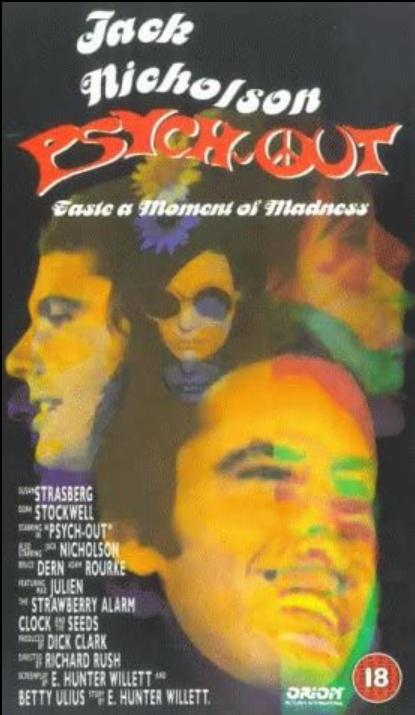
A few days later, I was informed that the client was Dick Clark Enterprises and the caller was Dick Clark himself. No wonder he sounded so deflated at the end of the call. What surprised me was learning that his production company had produced a film called “Psyche-Out” which featured sex and drugs, albeit in a much more tame, moralizing format than “The Trip”. I never saw it but understand it was the kind of film I would have liked to have seen while stoned at a drive-in with friends in a smoke filled car. From the trailer I’ve viewed on the IMDb website it was very laugh worthy.

Dick Clark wasn’t pleased © Robert R. Feigel 2022 – All Rights Reserved
Getting there …

The invitation to come over to Maui had been a godsend. At a friend’s house in Malibu, I’d run into Ron B – a Santa Barbara surfer I’d met a few years earlier. He was a neat guy, full of energy and enthusiasm and his descriptions of his new life on Maui had captured my imagination.

I’d always wanted to go to Hawai’i. In the early sixties, I almost made it, but lost the money for my trip when I invested in what was supposed to be surfing’s first full length movie shot with 35 mm film. As it turned out, “Hotdog On A Stick” never made it to the silver screen and the Hawai’i money was gone.

The more Ron talked about Maui, the more I wanted to escape. But by crunch time, Ron had returned to Maui and I phoned him in Hawai’i at the number he’d given me. The idea of pulling up stakes and taking off to Hawai’i had many attractions, but I wanted to make sure the invitation still stood.

Ron not only assured me that I was still welcome, he said I would have my own room at the house he and one of his friends rented, that I would have the use of a car until I found one to buy. He also told me that he could get me a job.

It sounded too good to be true and it was. But I wasn’t to know that just yet.

The long flight from LAX over endless ocean wasn’t as boring as I’d expected. I found myself sitting next to a man who introduced himself as Angel Romero. In the seat next to him was a guitar. We spent the flight talking about an eclectic array of subjects and he was particularly interested in finding whatever he could about surfing.

Before we landed in Honolulu, he wrote down my name in a small notebook and told me that there would be two tickets waiting for me at the door of the concert he and his brothers were giving that night. “Just come to the ticket office before the concert and give them your name. And after the concert you can come back stage and meet my brothers.”

Instead, I flew out on my connecting flight to Maui with my board because Ron was going to be there to meet us. It wasn’t until I saw Angel’s photo in a newspaper on Maui that I learned that the Romero Brothers were considered to be some of the world’s most accomplished guitarists.

Ron met me at the airport where my surfboard joined some others on top of his car and my suitcases put in the trunk. “Change of plans, I’m afraid,” he said. “We can’t go back to the house for a couple days, so we’re camping out by Honolua Bay in one of the pine plantations for a few nights.”

“Not a problem,” I replied. “Besides, I’m off to the Big Island in two days anyway. Got to meet up with my dad, stepmother and little brother for a week.”

Just before I left for Hawai’i I’d called my dad to let him know where I was headed and he told me that he and my step-mom and brother, Lee, would be staying at one of the big resorts on the Kona Coast around the same time. So we agreed to meet and he arranged for return airline tickets for me to pick up at the airport in Kahului.

After spending two dreamlike days surfing the incomparable Honolua Bay and camping out, the time had come for me to fly off and meet my family on Hawai’i. After being assured that Ron would meet me back at Kahului on my return, I packed up a few changes of clothes and left everything else, including my board, with Ron and flew out on an inter-island flight to the Big Island.

The energy on the Big Island seemed much less laid back than on Maui, but that probably had more to do with being at a resort than anything else. The food was excellent and I spent a lot of time sitting around the swimming pool being waited on by the courteous but distant hotel staff.

One afternoon, I took my brother, Lee, down to walk along the lava rocks that ran along the coast below the resort. The bottoms of my feet were like leather, so I didn’t think I needed to wear anything, but I slipped into one of the shallow tidal pools and got zapped by a few sea urchin spines above the back of my heel where the skin wasn’t so hard.

They stung like hell and while I sat down trying to figure out how to remove them, an old Hawai’ian who’d been fishing off the rocks came over and asked me what was wrong.

“Just wondering how I can get these spines out of my foot. They hurt,” I told him.

“Ahhh …” he said, shaking his huge head slowly. “Put ‘em in one bucket and peese on ‘em.”

“I’d known a few Hawai’ians over the years, so I was used to deciphering pidgin. But I wasn’t sure I’d heard him right.

“Piss on my foot in a bucket?” I asked.

“Put ‘em in one bucket and PEEESSSSE on ‘em.”

Later, at the hotel I asked one of the staff what he’d recommend and he brought me a shallow washing bowl big enough for my foot and a bottle of vinegar. When I asked him about what the fisherman had suggested he said, “Even better. The uric acid dissolves the spines better than vinegar.” So I ended up pissnig on my foot after all.

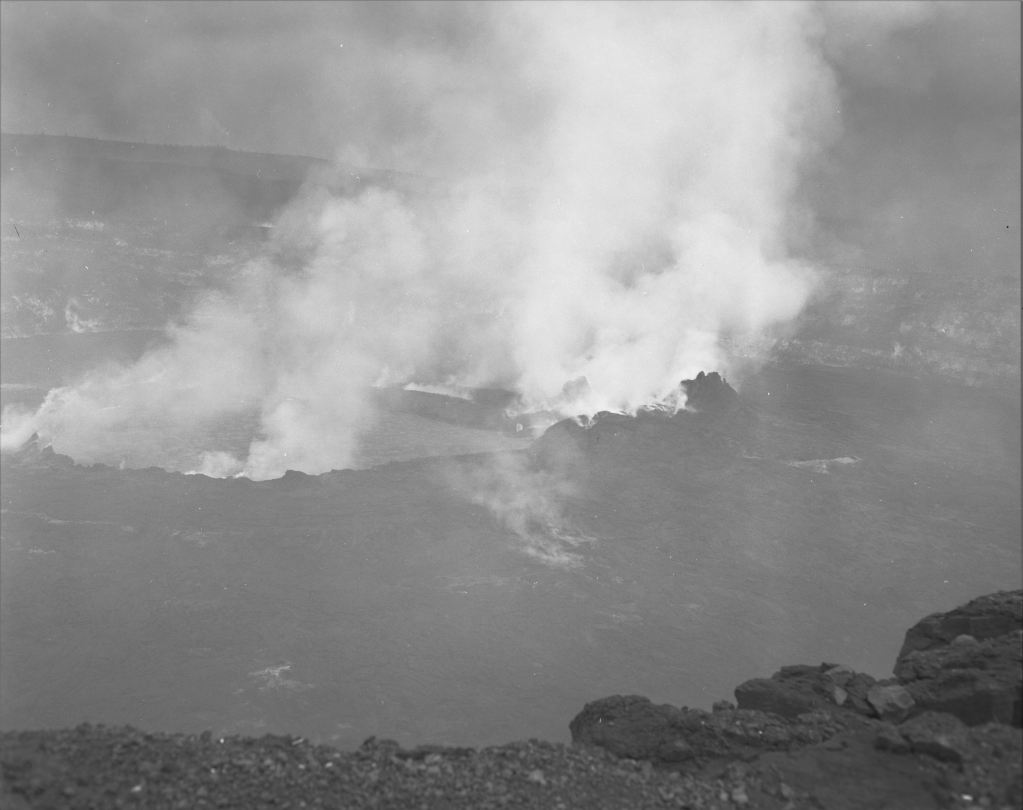
A day or so later, the family went up to the national park around Kilauea Volcano. After spending the morning walking around the park, we stopped for lunch at the park center’s restaurant overlooking the crater. The food wasn’t wonderful, but after our long walk, we were pretty hungry.

Not long after we were served, a park ranger who looked a bit like an anorexic Smoky the Bear, walked into the crowded restaurant and made an announcement. “Kilauea Volcano is erupting. There is no immediate danger, but we are evacuating the area as a precaution. Please leave your meals, return to your cars or tour buses and leave the park.”

Halemaʻumaʻu crater

For a few moments, everyone sat there in silence as a handful of diners got up and walked to the counter to pay for their meals. But most of us simply resumed eating.

Maybe five minutes passed and the park ranger returned. “This really is an emergency,” his voice tense. “I am ordering everyone in this restaurant to leave immediately.”

Since we were only halfway through our meal the idea of leaving it unfinished didn’t hold much appeal, and my dad wasn’t pleased. “Then don’t expect us to pay for our meals.”

At that point the manager of the restaurant started arguing with the ranger and the whole scene became unreal. Although we couldn’t see any major signs of an eruption, we could now see swirling plumes of smoke coming from the direction of the crater and the smell of something acrid in the air.

The restaurant manager was insisting that all of us pay whether we’d finished our meals or not, and the ranger was losing his temper with everyone including the manager. Finally, my dad stood up, said, “Right. That’s it …” and walked towards the door with us in his wake. The manager attempted to stop us for a split second, but my father, who was 6″5″ simply looked down at him and he moved quietly from our path.

Once we were outside I expected to hear something, but instead there was an eerie silence. Something in the air made our noses burn and some people were coughing as they moved to their cars. All the tour buses had already left and clouds of smoke were drifting across the sun. But instead of making it cooler, the cool air we’d arrived to had become hot and humid. We left without any further encouragement.

After a week, my time with the family came to an end and I returned to Maui. There was no one there to meet me at the airport, so I figured that Ron had either forgotten or something had come up. So I took a bus to Lahaina to look around for him.

Hours went by and I started to wonder what had happened. Then, just as I was starting to think about checking into the Laihana Inn for the night, a funny looking van pulled up and the driver leaned over to talk to me through what should have been a door. “You’re Bob Feigel, aren’t you?”

I nodded.

“Rick Segoine. Remember … we met a few years ago in Malibu? Ron asked me to look out for you. Jump in and we’ll shoot over to my place. All your stuff is there. I’ll explain on the way.”

I discovered that Ron’s housemate had been selling drugs and that they both had left the island and returned to the mainland just ahead of an arrest warrant. On their way to the same airport where I’d arrived earlier, they dropped off everything I’d left with them and asked Rick and his wife, Toni to look after it for me.

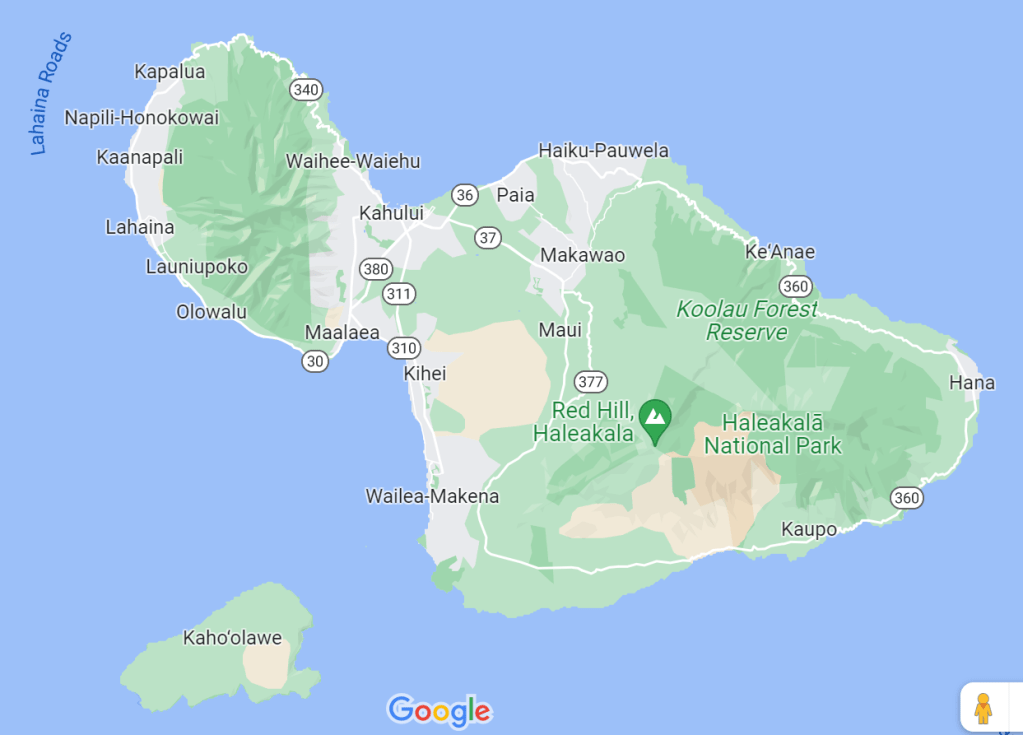
Rick and Toni and their little daughter, Jamie lived in a rambling old house north of Ka’anapali just off the Honoapiilani Highway in Honokowai. If I thought Maui was peaceful, then this was a haven of peace within it.

Rick and Toni welcomed me into their home and in staying with them for those few blissful days, I was allowed to relax and shed all my mainland tensions. I’d finally arrived in that wonderful wonderland of Maui. 


Getting there © Robert R. Feigel 2022 – All Rights Reserved
The Maui Chronicles …

One of my early ambitions was to go to Hawaii. It started while watching the Harry Owens’ Show on television. Even thought it was in black and white the music, dancing, settings and Hilo Hattie fascinated me.

Once i got hooked on surfing in high school I wanted to go even more. I’d been working as a boxboy at a local supermarket and had saved up $500 so I figured I’d just buy one of those cheap tickets and fly over and live on the beach.

Of course I hadn’t reckoned on getting my parents’ permission. My mom and dad would have to agree and that rarely happened since they separated and divorced shortly after my 1st birthday. I was planning to just get on a plane an go without their permission.

Someone I knew from high school had decided to make a surfing movie. His idea was novel for the times. All the surfing movies around were 16mm films narrated live by the movie maker, with some accompanied by some music on tape. They’d be shown in school auditoriums or, for the major movies, in places like the Santa Monica Civic Auditoriums. They were usually sold-out.

But this movie was to be shot with 35mm film with a soundtrack. And it was to have a story about “hotdogging” in Southern California. The working title was “Hotdog On A Stick.”

My school acquaintance was looking for investors and since I knew some of the other people involved I invested my $500 and lost it when the project fizzled out. So it wasn’t until 10 years later that I was able to follow my dream to Hawaii after making a difficult decision in 1968.

The company my friend, Bill Cleary, and I had been working for was being sold to a group of businessmen who recognized the influence YARI (Young American Research Institute) and it’s publication the Young American Report had in the marketplace. All the major networks and major corporations like Ford, General Motors, Proctor & Gamble, Pepsi, Mattel, Paper Mate, Schick and even Dick Clark Enterprises were using our research to help them understand and exploit this growing but fickle “youth market.”

The company’s founder was none other than Larry Stevenson, the same man who kickstarted what was termed the “skateboard craze” with his Makaha Skateboards and skateboard team, published SurfGuide Magazine and created the popular “Surf Fair” and “Teen Fair” exhibitions. If anyone understood the youth market it was Larry. But the key was scientifically based market research and nobody had done that before with this new market. Young American Research Institute’s director was the head of the market research department at the UCLA graduate school of business. It was unique and some big players wanted it for themselves.

One of the big players was Patrick J. Frawley, the founder of the Paper Mate pen company and the boss of Schick. Another was wealthy businessman and founder of the John Birch Society, Robert W. Welch Jr. The third was a wealthy businessman and member of the John Birch Society whose name was never mentioned. The three were buying the company.

Bill and I were informed that things would essentially remain the same. Business as usual … except our offices would be moved to one of newly built twin multi-story tower buildings overlooking the freeways in downtown Los Angeles.

Our current offices were in a beautiful little single story Mexican-style office complex in Santa Monic where we looked out on a lovely patio with trees, stone benches and and a fountain. The new office would be in one of two black glass towers.

Shortly after the announcement Robert F. Kennedy was murdered in Los Angeles after a successful campaign appearance at the Ambassador Hotel. Even though I was a registered Republican (like my parents) I was deeply affected by JFK’s murder and was planning on voting for RFK if he got the nomination. Along with millions of others, I was stunned.

The first to jump ship was my friend Bill. I’d been working under him as assistant editor and learned that I’d retain that position when we moved. We’d been promised “corner offices,” in a building that was more or less round. We’d also been promised our own, dedicated secretary and office machines. We both had been offered substantial salary increases, parking spots and other inducements designed to make up for the long commutes from Topanga Canyon where I rented and Bill and his wife owned a lovely home. But now that Bill had tendered his resignation I had to consider my options.

While it was Bill who’d met with the new owners I was left out of that meeting because I was simply Bill’s right hand man. Now I was summoned to a meeting where I was offered Bill’s job. I’d be the new editor of Young American Report with the salary hike and perks Bill had been offered. I’d also have the exclusive use of a company car since my VW Bus was hardly the kind of transport they wanted their editor to be parking next to them.

WOW!

It was all getting quite real and I needed to make a decision quickly.

It took me a couple of days to weigh up all the options. Since I could afford a much higher rent than I’d been able to pay previously I could either move closer to downtown LA or simply put up with the daily commute from Topanga Canyon or Malibu. Even Santa Monica was an option.

On the other hand, I’d be spending less and less time near the beach and my friends. I called Bill to discuss it.

Bill told me what he didn’t tell them. The reason he turned down the offer. He always called me “Fig” when we discussed anything personal. His wife and I had been friends for years. Close friends.

“Fig … do you know who these hombres are? They are the enemy.” He waited for me to catch up. “They want the company so they can use it to influence the market, not understand it. They want to manipulate the research to support their agenda … and that agenda is so far right it’s scary.”

To be honest I hadn’t considered any of this. I was focused on things like salary, cars and being the editor in a corner office.

While all of this put a new perspective on the job what happened next made an even bigger impact. A surfing friend who’d gone to Hawaii dropped in on his was back to the Islands. His name was Ron Brown and he described his lifestyle while living on Maui and invited me to move into the house he and a couple of other guys rented. It sounded like paradise.

By the time he left the office I’d made up my mind. I tendered my resignation and started selling off the things I couldn’t take with me. I traded my VW Bus for a Plymouth station wagon and a Kawasaki 125 dirt bike. I sold my stereo and tape recorders. Most of my books went to friends and I only kept a couple of favorites. The last thing I sold before buying my ticket was the station wagon because I didn’t need that either. But before I did I used it to take my dirt bike down to San Pedro where I consigned it to a Matson ship to be delivered to Maui.

After wrapping my surfboard in a couple of wool blankets and checking it in to a Pan Am flight I was on my way to Maui where my friend picked me up from the airport where my Maui Chronicles begin.

The Maui Chronicles © Robert R. Feigel 2022 – All Rights Reserved

Why NZ is in trouble

The point of the cartoon being that NZ is being criticized for it’s admittedly Draconian lock-downs and mandates by people in countries that have experienced major Covid outbreaks and tens if not hundreds of thousands deaths compared with NZ’s few deaths and far smaller outbreaks.

On the other hand, NZ enjoys natural advantages these other countries don’t. We’re an island nation that is many miles away from any other country. It’s not like the UK or Ireland.And it’s not like continents where counties share their borders.

So NZ was in a unique position to avoid the influx of infected people. In fact, our outbreak would have been far less had the government closed down our borders a lot more quickly than it did. If anything, the government was far too slow to act and far too complacent and inept once it die.

In my opinion, the problem we have in NZ is that the government had no forward planning for any sort of pandemic despite the various warnings. NZ is a country used to “crisis management.” The government is not proactive, it is reactive. It’s always on the back foot regardless of the crisis.

To make matters worse, the current government is made up of career politicians with no practical knowledge outside of politics and they rely on advice from career bureaucrats who have no practical experience outside of the bureaucracy. It’s the blind leading the blind.

To make matters even worse, our current government is governed by a socialist agenda based on a far left ideology that is as close to Marxism as you can get without being Communist.

While the media and most Kiwis have been focused on the pandemic and the measures imposed by the government, the same government has been implementing legislation that will ruin various economic sectors the government’s ideology would like to see ruined.

The hospitality businesses. Beef and dairy businesses. Rental businesses. Small businesses. You name it. If it makes a profit then it’s a target.

All this harkens back to the period that our current PM’s mentor and employer, Helen Clark, ruled the roost. Clark traded off NZ’s sovereignty and independence to pave her was to a job in the United Nations. Her aim was the top job of Secretary General, but she missed out.

Now, her successor – Jacinda Ardern – is using NZ’s economy and freedoms to achieve what her mentor didn’t. She’s ruining the economy in order to make Kiwis reliant on government handouts and support so they’ll continue to vote for a socialist government.

For awhile there I thought that “ordinary” Kiwis would never see through Ardern’s well orchestrated act. That they wouldn’t see how so many Kiwis had been manipulated – with the help of the media – to fool them into believing that a bunch of amateurs in government were there for the good of the country rather than their own good.

I’m hoping that the wheels have truly fallen off the juggernaut. That the National voters who thought voting for Labour would keep the Greens out now realize how easily they were fooled.

Commentators are right in saying that the demonstrations at parliament are not just about the Covid mandates. They’re about the whole nasty mess this current government has made of the economy and NZ’s future. It’s about stopping the pendulum from swinging so far Left that there’s no return.

The sooner the voters decide that Jacinda Ardern and her politburo of self-serving amateurs is better off ruining the UN than NZ, the better.

Why NZ is in trouble © Robert R. Feigel 2022 – All Rights Reserved
The art of the Costa Rican “Boca”

There’s a custom in Costa Rica that puts other countries to shame. Or at least when I lived there in the early-70s.

“Bocas” (pronouced with a soft “b” almost like a “v.” Bocas/Vocas. Something you put in your mouth.

It’s the custom of offering your guests a little food with their drinks and the Ticos have turned it into an art.

When I lived in CR in the early-70s the poaching and selling of turtle eggs were against the law. But as my Tico friend Fede used to say, “Just because something is forbidden doesn’t mean it’s not allowed.”

Most of the small bars my friends and I would frequent offered turtle eggs in their “bocas.” One particular place in San José seemed to love gringos. One wall was plastered with photos of the pope and Catholic icons. Another featured framed photos and magazine cutouts of JFK and Jacqueline. But the wall behind the back counter was covered with center folds taken from Playboy Magazine. Ahhh … the Latin Paradox. Worship the virgin. Lust after her opposite. Then pray for forgiveness.

The bocas there were particularly generous and served on a multi-tier stand like it was high tea at the Ritz. The bottom tier was the biggest and had things like small tortillas with refried beans or with beans and chicken or beef. The next one up could have fried or BBQ chicken legs and wings and slices of cooked beef. Next to the top there’d be small containers of dipping sauces and big cooked prawns. And on the top maybe aged turtle eggs, marinated chicken eggs or pieces of freshly cooked lobster.

All this would be accompanied by bowls of pretzels and salted peanuts. But I’d pass on the eggs because they didn’t looked that appetizing. “An acquired taste,” said Fede as he consumed them all with a shrug.

So we’d go in for a couple of excellent CR beer (thanks to the Germans who helped build the railroad on the Pacific side from San José to Puntarenas) and leave having been treated to a feast.

It’s a custom that I understand has grown to be even more generous and diversified as CR has become home to more and more North Americans and Europeans.

It’s also a custom I provide for friends and family here in Aotearoa New Zealand. Only I’ve changed the name to “munchies.” Maybe I’ll go back to calling them “bocas.”

The art of the Costa Rican “Boca” © Robert R. Feigel 2022 – All Rights Reserved

The Costa Rican Chronicles

In the early-70s a friend and I drove from Malibu down through the center of Mexico and on through Central America to Costa Rica. My friend wanted to give his marriage another chance and I accompanied him back to Malibu so I could pick up my VW bug and drive down again. I’d been offered the job of assistant manager at a major hotel in El Salvador and headed back down on my own.

If you’ve read about that adventure in “Kidnap in Oaxaca’ you’ll know that I missed out on the job and decided to return to Costa Rica, where I lived for over a year. I’ve created this section for my Costa Rican adventures.

After I got ripped off by a couple of Costa Rican business partners I decided to leave and return to Malibu. I sold most of my belongings, including my car. Two old friends let me hitch a ride with them when they returned to the USA and we parted ways in Texas so they could carry on to Louisiana while I hitched across country to California.

More adventures to write about there as well.

Costa Rica continued to call me and I’ve returned there several times to visit friends.

The Costa Rican Chronicles © Robert R. Feigel 2022 – All Rights Reserved

My Hānai  Mother – Part IV

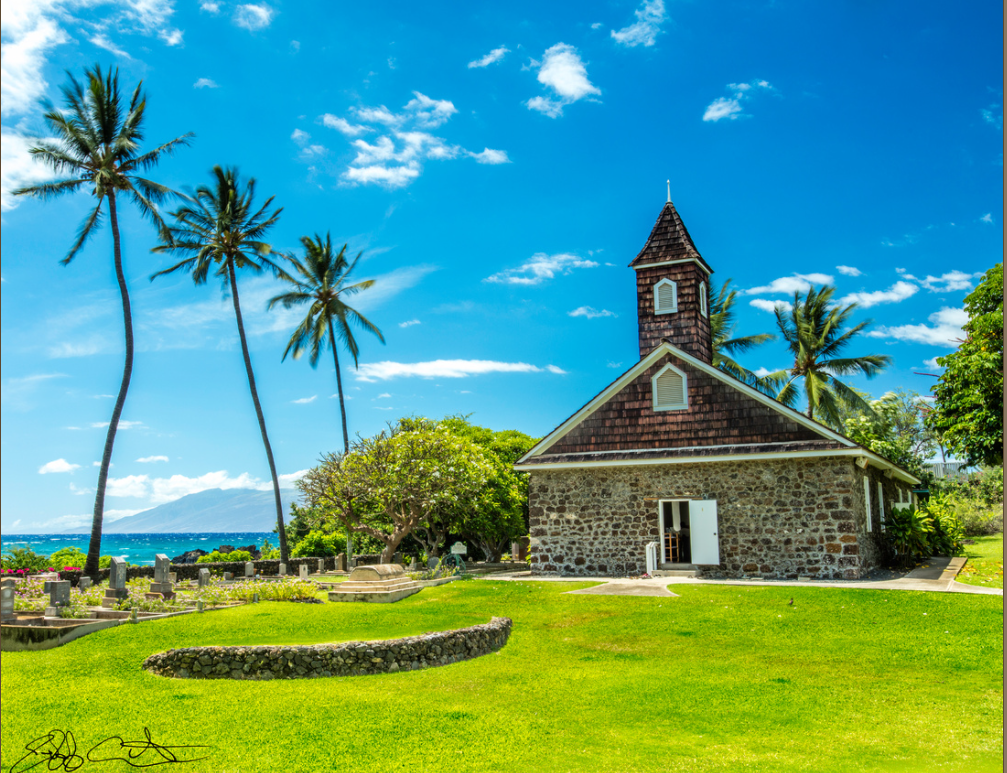
A few days later Helen asked me to drive her down to the Keawala’i Congregational Church in Makena. After showing me around to several graves, telling me who was buried in them and what place they had in the family she took me aside and said, “You know I’m a good Christian, but we also have our own traditions and beliefs. So I’m going to show you some things you must not show anyone else.”

Helen had already shared some of her healing remedies with me. She was the family healer and I learned that one day when someone had brought her a child who’d broken his leg. It had been set and put in a cast in the hospital, but they’d brought him to Helen so she could “help” the healing. She took me out and showed me the young leaves of a certain tree, told me to pick them for her and brought them back where she used a mortar and pestle to pulp them and make a tea the boy was made to drink. She also said some words in Hawai’ian while passing her hands over his cast. She’d explained what she was doing at each step.

So I knew she was a healer and that she was teaching me. Now I’d learn that she was a shaman. She was a kahuna lāʻau lapaʻau. 

We walked a way behind the church to a certain spot where she introduced me to a certain tree. Then a large rock or stone she explained was sacred. And finally down a path she’d chosen to a place along the shore above the ocean. She told me that this was where the spirits of her ancestors would visit and help the living. She told me how they were summoned. In a way I can’t describe I was visualizing and hearing the scenes she was describing to me. She told me that I needed to know these things because I was joining the family. So I’m respecting her wish and not describing the Wahi Pana in detail.

For the next few months I saw little of anyone outside the extended family and they’d speak to me in Hawai’ian. So I was slowly and unconsciously finding myself conversing with them, and to such an extent that I had to consciously switch back to English.

One day that all changed so suddenly that I took some time for me to adjust. Helen arrived at my door looking down and depressed. I’d never before seen her like this. Angry, yes. Worried, yes. But never like this.

She started off by apologizing to me for the hurt this would cause. She was also upset by the “shame” it had brought on her family. Her granddaughter was pregnant. It still hadn’t gotten through to me that all this had been about me marrying her granddaughter. A friend had joked about the significance of the pikake lei, but I treated it as a joke. The suggestion that I’d proposed to her island style didn’t resonate.

According to Helen, the granddaughter had had a brief but clearly significant affair with a “carpet layer” who was working in a crew that put in new carpet in the place where both Helen and her granddaughter worked. Not that a bride is expected to be a virgin in Polynesia, but at least pregnant with the groom’s child.

The penny finally dropped. The granddaughter and I were never close. Far from it. I thought she disliked me and everything I saw confirmed it. I imagine the marriage had been the family’s idea and she went along with it because she wasn’t given a choice. Maybe getting pregnant was her way out of it. It was certainly mine. Laid by a carpet layer!

My relationship with Helen remained close. But I was no longer being trained up for something in the future. I was back to where I started. Not ostracized. Close, just not one of the extended family anymore.

I still had some amazing experiences and Maui continued to be what I came to refer to as a “cosmic playpen in a crystal sea.” But more of that later.

My Hānai  Mother © Robert R. Feigel 2022

My Hānai  Mother – Part III

I knew Helen was ali’i and that her ancestors ruled this part of Maui before and during the reign of Kamehameha. Apparently this woman was a hereditary matriarch of some kind. She was dressed with a casual elegance that meant both money and taste. I admit to being so taken that I failed to register her title when we were introduced because her name was very VERY long and I’m pretty sure her title or titles were part of it. In any case she was clearly respected by everyone there and they deferred to her while continuing to joke around and enjoy themselves.

Tutu and Helen introduced us. She smiled and said something in Hawai’ian. Then she scrutinized me up, down and around like like someone at a horse auction. Without a warning she casually reached down to my thigh, pinched it, smiled and turned to Helen and Tutu. “He’ll do,” she announced.

That caused an eruption of laughter and applause and I was about to ask her who she was when a more formally dressed man explained that she’d just flown over from O’ahu and had to get back to the Maui airport for her return flight.

Before she left she stopped briefly to gently brushed the back of the fingers of her right hand across my cheek and said, “Well done.”

What the hell is going on? At this point I had no idea that everyone thought I was marrying into the family. But I was starting to wonder about what appeared to be tests when the next test emerged.

A group of older teens were talking among themselves while looking at me when one broke off from the group, walked over to me with a bowl of small red chili peppers and asked if I’d like to try one. I asked if it was hot and all he said was “one small pepper. Tiny.” and returned to the group.

Just being friendly? When I bit into it and noticed that the group was watching me closely. Then it hit. I know I turned red and started to sweat. I also know I’d been set-up and that it was another test. As I looked around for some water I was handed a beer … and more beers. If this was a new test I wasn’t about to fall for it. But at least I’d provided some entertainment.

My Hānai  Mother © Robert R. Feigel 2022

My Hānai  Mother – Part II

My invitation to the luau came after I’d spent some time with “Tutu woman” and her husband “Tutu man..” They arrived on one of my days off and we drove around in their vintage WWII Army surplus jeep while Tutu (that’s what everyone called her) would point out various landmarks and their histories. On the way back from Lahaina one day the tourists were queued up behind the slow moving jeep when Tutu waved her hand dismissively and said, “Silly haoles. Always in a hurry. Don’t they know they’re on an island and all they’ll do is go around in circles faster?” It was almost as if I was no longer classified as a haole.

The so-called invitation was more of a summons. Tutu Man arrived one evening in the jeep after dinner to inform me that one of Helen’s grandsons and I were to accompany him “down Makena” to Makena Beach, which was part of Helen’s ancestral lands.

We were to bring something to sleep on because we were to be spending the night on the beach.

Tutu Woman was short but “well provisioned.” Tutu Man was short and wiry without an ounce of spare flesh. It looked like he’d been carved out of aged teak, but his legs were bent by age. He moved slowly on bowed legs, but with purpose.

We got to Makena and carried his fishing gear down to a spot he decided was ours. We put our blankets down while he baited some hooks. He explained that he’d be swimming out beyond a reef (I didn’t eve know there was one), dropping his multi baited hooks and leaving them until morning. It was getting dark so it was time to sleep.

Something woke me in the night. I no longer wore a watch so hadn’t a clue what time it was. The night sky was bright with blurred stars and not another person but us in miles. Van Gogh could have painted it. Ore Monet. We were both myopic.

I became aware of a sort of rhythmic humming that seemed to be coursing through and all around me. My glasses were close so I put them on. There, pulsing slowly along the skyline was the biggest “thing” I’ve ever seen. I’ve compare it to a jellyfish but the shape would be wrong. It was like a gigantic, oblong bubble full of pulsating lights. It looked like a city could fit into it, but it seemed like a living thing. Pulsing and changing colors as it moved. In a way it was like I was looking a plankton or a living cell through a microscope. Only I was at the wrong end.

I tried to wake up my companions but no. They either wouldn’t or couldn’t wake. So I just sat there on the beach watching this amazing spectacle as it pulsed slowly across the sky until it disappeared from view and I went back to sleep.

Next morning we were woken up by Tutu Man. He’d already retrieved the night’s catch and gave us the job of hauling them back to the jeep. Then we drove back to Tutu’s house up from the Keawala’i Congregational Church near Makena Landing. The church is where Helen took me on Sunday to meet (or rather be checked out by) one Rev Kukahiko. I’d heard of him long before I’d met him. Legend had it that when the corporates started developing Ka’anapali Rev Kukahiko warned them that they were going to digging up the ground on which the final battles were fought to determine if King Kamehameha I would rule all of the islands. The area was sacred or “kapu.”

According the legend he warned them that the land was cursed and needed someone like Rev Kukahiko to lift curse before work was commenced. Of course the developers were dismissive and ignored the warnings until their heavy equipment started sinking into the earth that would one day become golf courses. Work had to be halted and Rev Kukahiko was brought in. He arranged for the proper rituals and work resumed. Helen told me that his ancestors were ‘kahunas’ or Hawaiian shamans.

Part of my initiation to the family was attending a service at the Keawala’i Congregational Church and spending some time with this powerful, charismatic man afterwards.

Keawala’i Congregational Church

After carrying the fish to the tables set up for cleaning and preparing the fish I was introduced to the growing assembly. All of them were Hawai’ian except me. Lots of mixed race, but even though I was quite tan, I was the only white person. A lot of Hawai’ian was being spoken and, thanks to Helen, I could understand and speak a bit myself.

Everything that I was involved with took place outside. Tables, chairs and food trestles were all outside under pergolas, some covered with bamboo blinds to provide shade. The house itself was more of a cottage and the women and girls were constantly going in and out with plates of food. And the food was delicious. While everyone was dressed casually a couple of the men were dressed more formally in slacks and open neck short sleeve business shirts. Me, I was wearing shorts, t-shirt and flip-flops.

Not being a meat eater I skirted the various pork dishes (no doubt from the upcountry family). I was told the tomatoes also came from upcountry where it was cooler. Macaroni salad was one of my favorites and the lomi-lomi salmon was superb. Lots of fish dishes and some tasty seaweed dishes I’d never tasted before. Beer flowed like wine and the ubiquitous Kool-Aid. Stacks of white bread and margarine. Lobster. Shellfish, both raw and cooked. It was a feast.

At one point everyone’s attention shifted from food, drink and conversation to the arrival of one of the most amazing women I’ve ever seen. I’m 6’3″ and she was taller. Statuesque doesn’t even come close. She was stunning, but not just for her physical appearance, but for her demeanor and presence. It was like I was in the presence of royalty. And I was.

My Hānai  Mother © Robert R. Feigel 2022 – All Rights Reserved