

These days it’s not so unusual to find man-made waves inland from natural breaks on a coast. Arguably, some of the waves replicate the real thing so well, that due to their reliable shape and frequency, they offer more rides more often than a natural surf break. And these days you can find wave parks of various sizes and quality in Japan, Europe, Australia and around the continental USA.
That wasn’t the case when I visited the wave park described in a story I wrote many years ago and published on my surfwriter website. That fictional story, The King Of Mush Mountain was based on a real experience I had back in the early 1970s at a place called BIG SURF in Tempe, Arizona.
Like so many things in my life I followed my “little voice” and found myself having yet another adventure I’d have missed had I not been listening. This is the story behind The King Of Mush Mountain.
BIG SURF Arizona
One day I was out surfing at Old Joe’s in front of my friend, John Kiewit’s, parent’s house in the Malibu Colony when John’s father, Ralph, cruised by on his Hobie Cat and yelled out, “Hey Bob. Want to earn some money?”
At the time I was between jobs and waiting for the new job to start in a few weeks time. So the thought of earning some money had a certain appeal.
“Sounds good to me,” I shouted as he sailed past.
“Come up to the house later,” he yelled after he’d jibed and sailed past again.
Ralph owned one of the biggest construction companies in the country and wanted me to do a one-off job for him. I was to fly down to Florida, pick up a new Ford pick-up truck at a huge project his company was finishing off on the eastern coast of Northern Florida and drive it back to the company’s California headquarters.
The pick-up had a locked reinforced steel box built into bed at the back of the cab and, cushioned in foam rubber, the box contained some newly developed laser surveying equipment that was worth several new pick-up trucks in those days.
All my expenses would be paid, I’d be paid for driving the valuable equipment back and I had ten days to complete my mission.
A two days later, Ralph handed me the airline ticket, an envelope containing a thousand dollars in twenty dollar bills and a credit card that I could use at gas stations.
“This should cover your expenses, but if you need more let me know and I’ll wire it to you,” said Ralph. “You can keep whatever you don’t spend and don’t bother with receipts except for gas.” Since cheap motel rooms were around $25 or less a night and food and drink could cost me less than $20 a day, I was on my way with a smile.
The flight down was memorable only because my connecting flight to Florida was delayed and I was put up in a tiny hotel room at the Dallas/Fort Worth airport overnight. The room was designed for pigmies. It featured a small, uncomfortable bed and a window that looked out onto a solid wall a few inches away. The airline paid for the room and my dinner. The food in the hotel was something you’d expect at a Denny’s and I didn’t get much sleep, wondering how I’d get out in the case of a fire.
The following morning the phone on the tiny desk in front of the useless window rang shortly after 4:00am and an enthusiastic voice informed me that my flight would be boarding in the not too distant future. I arrived in Jacksonville just a few hours later, was met by one of Ralph’s foremen, whisked away to the construction site near Jacksonville, handed the keys to the truck and started making my way back towards California before ten.

Before I left California I got an up-to-date AA road map and decided to return to California via Interstate 10 so I could visit New Orleans and a couple of other places. I figured I wouldn’t get another chance like this again.
From the construction site near the beach outside of Jacksonville I headed west across the bridge that connected to Interstate 10 and across the top of Florida until I reached Highway 231, hung a left down to Panama City and took the route along the Gulf Coast. As the sun started to set I found a small, funky motel, ate an amazing seafood dinner at an equally funky cafe and fell asleep to the sound of water lapping along the white sand beach.

The next morning I was up early and didn’t eat a late breakfast until I reached Biloxi, Mississippi where I made a complete fool of myself trying to chat up the waitress at a roadside cafe. After my second cup of coffee, I complimented her on her accent, adding that I really loved the way Southerners spoke. A first she just looked at me like I was crazy. Then she laughed and explained that she was actually German. And just in case I hadn’t got the message, she added that she’d met her husband while he was in the US Army stationed in Germany. Otherwise the breakfast was monumental. But it was clearly time to finish my coffee and be on my way.

Once I got to New Orleans I spent a lot of time looking around for a place to stay and settled for a small “hotel” near the French Quarter. I was able to park the pick-up on the street nearly directly in front and walk everywhere else. And walk I did.
In fact, I walked and partied and ate and drank and explored right through the night … and the next. I didn’t want to miss a minute of it and what I experienced and saw is another story in itself … even though much of it is so unbelievable that someone who hadn’t been to New Orleans in those days would consider it to be fiction. I’ll have to check on the statute of limitations.
In any event, I’d spent a few dollars during my two nights in New Orleans and was glad I’d taken along some extra money just for that purpose. But except for the alcohol, everything else was a lot cheaper than I’d budgeted for, including cover charges in the clubs.
After staggering out of New Orleans totally satiated, I reconnected with Interstate 10. Once I took a good long look at Baton Rouge, the going was fairly steady. I cut down on expenses by grabbing snacks at convenience stores, eating at fast-food places, stopping at places where I could sleep in my sleeping bag at the back of the pick-up and showered in public facilities at state parks.
There were some incidents along the way, like witnessing a fight between two gangs in a parking lot in Texas, but my only additional side trips were a quick visit to the Alamo in San Antonio and a memorable day enjoying Ciudad Juárez after leaving the pickup in a secured parking area in El Paso and walking over the border.

Otherwise, I drove from sunup to sunset … until I pulled off the highway and parked in front of a faux-adobe 7-eleven outside of Tempe, Arizona and went in to get a bean and cheese burrito and a beer to wash it down with.

As I stepped from the icy store back out into a blast of hot dry air, I was temporarily blinded by the glaring sun, blinked and thought I must be imagining things. Turing the corner of a nearby street were three boys on BMX bikes carrying small surfboards under their arms.
Curiosity got the better of me. I followed them and spent part of the day at the world’s biggest inland surfing beach described in the story. In real life it was called BIG SURF instead of Surf City. Except for that, the the story’s fictional Surf City was very similar to the real thing.
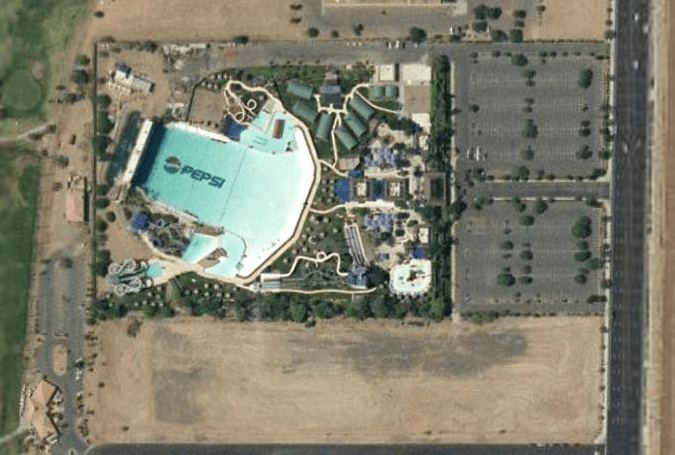
Courtesy of G Scott Imaging.

The Locals really did act as if they owned the place, the rest of the people really did look like they had been airlifted from a popular beach in Southern California and the board I rented was yellow. The girl who sold me my ticket smiled, the lard-assed ex-jock who took it from me was a jerk and my description of the wave machine is fairly accurate. Otherwise, the rest of the story pure fiction.
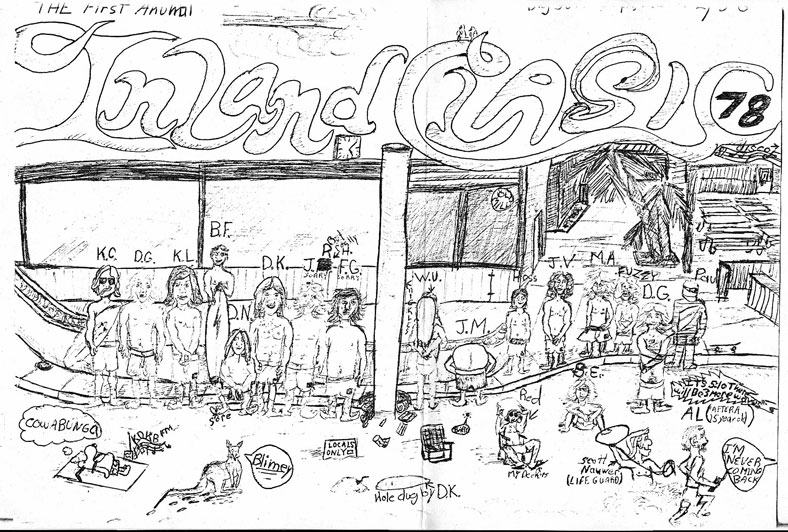
Courtesy of G Scott Imaging
(Click on this link for an enlargement of the drawing.)
Speaking of which, The King of Mush Mountain was my first attempt at writing surfing fiction – or anything else about surfing for that matter – since the demise of Surfguide Magazine and it’s vaguely reminiscent of Feigel Fables.
I first started writing it when I was living in Costa Rica and in the intervening years I’ve tweaked it here and there. But it’s mostly sat with other unfinished typewritten stories in a box until I scanned it and transferred the text to my computer. I finally finished The King of Mush Mountain earlier this week – around 35 years later. (14 June 2007)
EPILOGE
After I returned the pickup to Ralph Kiewit’s HQ in the San Fernando Valley and driven back to Malibu, Ralph thanked me with another envelop with a $1,000 plus a $500 bonus for returning everything in perfect condition. These days I see laser surveying equipment advertised for sale for far lower prices than what I was paid when when the nearly $2,000 I ended up with is converted into today’s value. But Ralph and his wife Oralee were very generous to me over the years and always made me welcome in their home.
BIG SURF opened in 1969 and was a popular attraction for many years. With the development of more realistic wave pools the gentle mushy wave at BIG SURF was marketed as a “Waikiki Beach Wave” and surfboards were replaced with surfmats and the beach scene became more of a family scene.
After over 50 years as one of Tempe Arizona’s major attractions the restrictions during the pandemic has led to what may be the permanent closure of BIG SURF.
(Television news story on closure)
In the meantime, generations will remember what was one of the first, if not the first, inland surfing experience in the 70s and the fun they had visiting BIG SURF. I certainly will.
Surfing in Arizona? YES! © Robert R. Feigel 2022 – All Rights Reserved
 Pieces from a Puzzling Life
