
One of the most valuable things I learned in school was how to type. It was by accident really. In junior high they had classes called “elective” that were supposed to teach you skills suitable to your gender. For boys the elective classes were also called “workshop.” I’d been assigned to woodworking which taught me how to pound in nails, saw a board and screw a screw. I can’t remember what project I brought home at the end of it, but it must have been unmemorable.
The second class was something to do with electricity taught by an aptly named, Mr Savage. His idea of a great way to introduce the subject was to have the all male class stand in a circle holding hands while the two boys at either end held onto electric cables attached to a hand operated generator while Mr Savage turned the crank. What Mr Savage didn’t know and probably would have enjoyed is that, as a young child I’d stuck one of my mother’s bobby-pins into a wall socket and got thrown across the room where I landed on a sofa. Mr Savage’s little demonstration left me shaken to the core.
Next I was assigned the “Mechanical Drawing” class. I was enjoying the class immensely until I discovered the new electric pencil sharpener and managed to use up an entire semester’s allocation of pencils trying to get the “perfect point.”
The school had to put me somewhere and since none of the other workshop teachers was willing to take me on and everything else was already filled I became the only male in the typing class taught by a pert woman who always wore suit. I think her name was Mrs Perez or something similar.
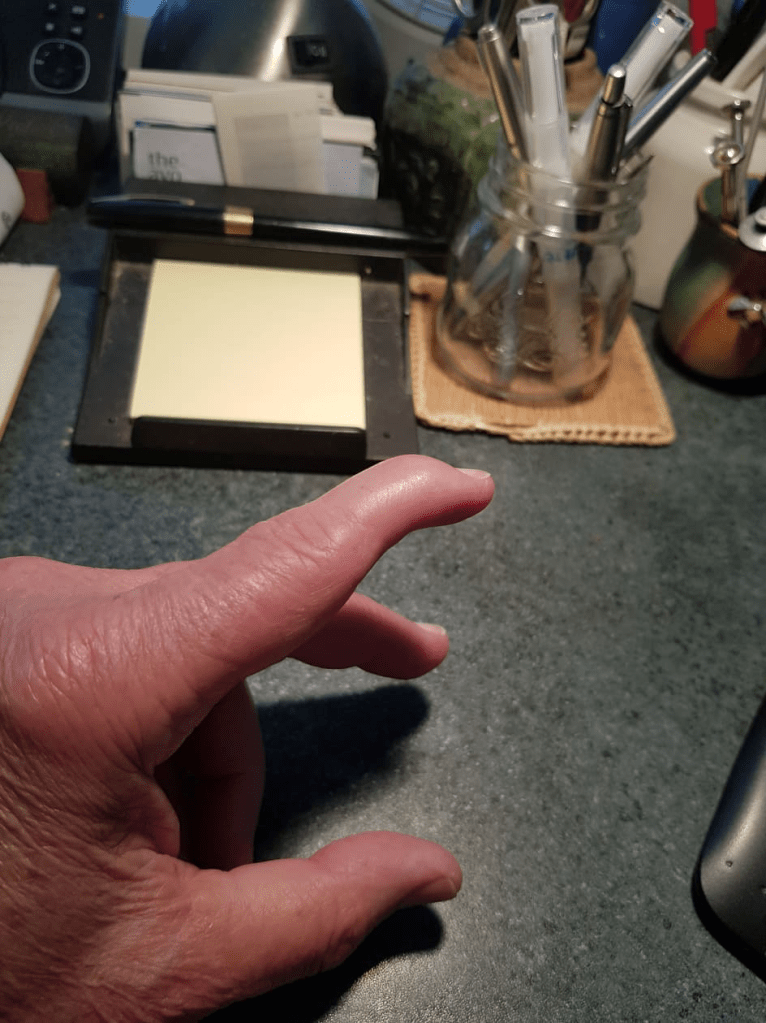
My mom was pleased because she thought that typing would be beneficial in strengthening the index finger of my left hand. It had been severed in an accident when I was three and reattached by a young doctor who’d returned from a field hospital in WWII with newly acquired skills in microsurgery. Because the more traditional doctors didn’t think his new surgical methods would work and were dismissive when they did, I was never afforded the kind of targeted physical therapy that would have helped the tendons, ligaments and muscles to develop. The finger remained stunted, bent and stiff.
To everyone’s surprise I became quite a good typist. Second fastest (based on speed and accuracy) in the class. Of course that was on a big, old Underwood that remained in the class.
My mom and stepdad bought a smaller model for me to use at home and I used that to type out all my school assignments from then on.
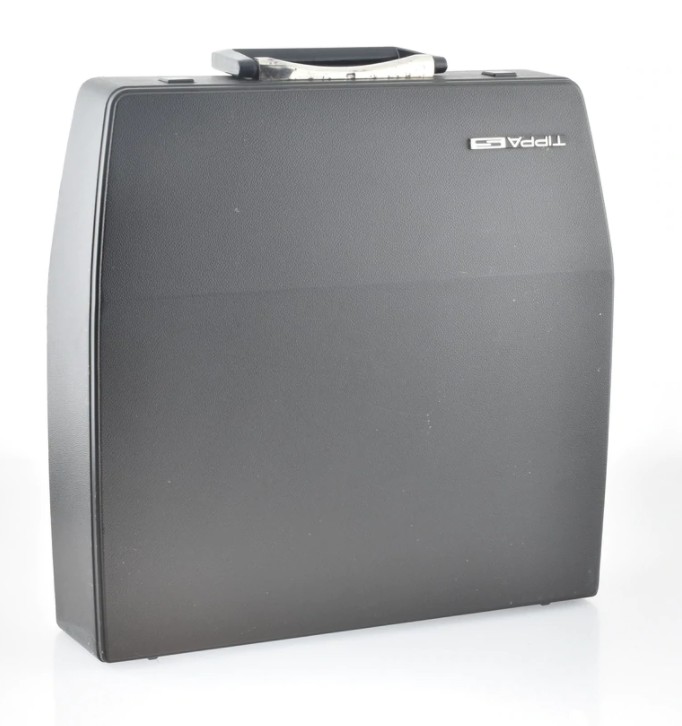
Years later when I started writing for a surfing magazine I used the typewriter in the office until my pal, editor and mentor, Bill Cleary, gave me his small Alder Tippa. He’d bought a new model and I used my new portable to write my monthly ‘Feigel Fables’. After being attracted a new Tippa model with a sans serif typeface in typewriter shop I’d taken it to for servicing, I traded it in for the new one.
It has accompanied me to the UK, Ireland, Hawaii, New Zealand and through Mexico, Central America and South America.
I haven’t used it in years and doubt my keyboard weakened fingers are up to using it now. But I still have it and I’ll never part with it.

I remember the joy of using my first electric typewriter. It was an IBM Selectric in the offices of Young American Research Institute (YARI) in Santa Monica where I was assistant editor of company’s monthly newsletter, the Young American Report (YAR). Subscribers included Fortune’s 500 and included all the major media networks and companies like Pepsi, Coca Cola and Dick Clark Enterprises, etc.
Our secretary had exclusive use of the IBM unless she wanted to “pop out” of the office and asked me to “cover the phone.” I’d use her machine to type personal letters using the different font balls for effect.
Of course the machine was far too heavy to tote around so I’d only use it for fun.
All my celebrity interview articles were typed on my Tippa and so where all the scripts and articles I wrote after breaking into the New Zealand market.
I was working for one of NZ’s major corporations, Progressive Enterprises, when my fingers experienced their next treat. The company owned and operated a chain of supermarkets (Foodtown), a chain of fast food outlets (Georgie Pie) and an early data processing company. Editing the company’s monthly staff magazine was a part-time job and I used the Tippa with the text being taken to an independent typesetter. But they offered me an additional job of operating the advertising department’s new computerized typesetting machine to produce camera ready headlines and copy for the company’s newspaper “specials” ads.
Once the freelance income from articles and scripts became more lucrative I quit those jobs. But not before gaining some skills I didn’t have before. One of the young guys who worked in the data processing department (a sealed suite of offices with floor to ceiling computer banks excreting miles of perforated tapes) got to be a family friend and when I left the company we kept in touch.
He introduced me to my first PC at an Apple demonstration show in Auckland. I liked the idea, but couldn’t afford to buy one. Instead, I bought a word processor made by Panasonic that saved my data onto a floppy disc and let me copy and paste, etc.
From there I got a job as senior copywriter at a radio station in Auckland. My job was to write and produce radio commercials and it came with an electric typewriter. So again, my fingers were allowed to rest. I used the word processor at home and the electric typewriter at work.
When we moved to Waiheke Island near Auckland the radio station refused to let me adjust my hours to accommodate the ferry commute from the island to the CBD. I resigned.
It was a big wrench. I love radio and I loved working at the station. My workmates were family and I missed the daily excitement, challenges and dramas. I missed my radio family. My office was right across from the newsroom and there was always something going on. I’d also miss the regular pay.
It didn’t take all that long for me to get another job. This time working for an advertising agency.as their “creative director.” The radio station had helped me learn how to produce commercials, pick sound effects and music, and direct the voice actors, etc. But it took a few tries before I learned how to communicate my creative “visions” to an art director who’d carry through that vision. Fortunately, I worked with several who’d tweak my ideas and, together, we’d come up with an even better result.
The same applied to television commercials and corporate videos. I learned that being a creative director meant embracing collaboration and teamwork. I loved it
During that period I’d gone from using a word processor to using a computer. The industry standard for “design oriented” or “art oriented” creative directors was a MAC. But I was a “copy oriented” ‘CD’ and Apple hadn’t (and still hasn’t) designed wordprocessing software that is anywhere near as good as what I’d stumbled upon.
I’d started on a Windows PC using the earliest version of Windows. The monitor was black with a green readout and I had to use a code book to operate it. That wasn’t a problem because the phototypesetter back in my Progressive Enterprise days had two code books each the size of NYC telephone books and I’d ended up writing code that was better.
No … the problem was that it wouldn’t let me see the what I’d written in a way I could relate to. It was flat, unattractive and dull.
So when Windows updated there ‘OS” and allowed for new software to be introduced I celebrated. I have never like Word for Windows. For some reason Microsoft screws up everything it touches. For reasons of pure greed they introduce new versions of Windows’ operating systems without perfecting them first and we, the users, are left with having to get endless “updates” to help them fix the problems they foisted in us.
Some of those updates cause even more problems than they solved and users are left to spend their time trying to figure out how to undo the problems Microsoft has caused. For example, hundreds of thousands of printers no longer worked with Windows systems after an update and it took weeks before Microsoft acknowledged the problem and provided a solution.

The software that opened the door to my personal creative process was LOTUS Ami Pro. Unlike the clunky, user-unfriendly POS Microsoft WORD, Ami Pro was full of features that made it possible for me to easily and intuitively design a document with text (fonts, headlines, etc.) and images. It was truly a WYSIWYG extravaganza that an anal retentive bureaucracy like Microsoft could never achieve … and still hasn’t.
Unfortunately, Microsoft used its corporate clout and monopoly to make its own crappy software the document standard and the far superior Lotus Ami Pro, Lotus Word Pro and Word Perfect disappeared.
I still refuse to use Windows Word to this day and use other software that emulates it while being easier to use.
Today I see the cyst that formed on a knuckle of my right hand has become less swollen and painful. Typing, even on my current Logitech keyboard, is not taxing. But it can strain what are becoming arthritic 80 year old+ hands. I didn’t have any idea where this was going when I started it earlier today and have no idea where to put it. But I hope you enjoyed it.
Cheers!
 Pieces from a Puzzling Life